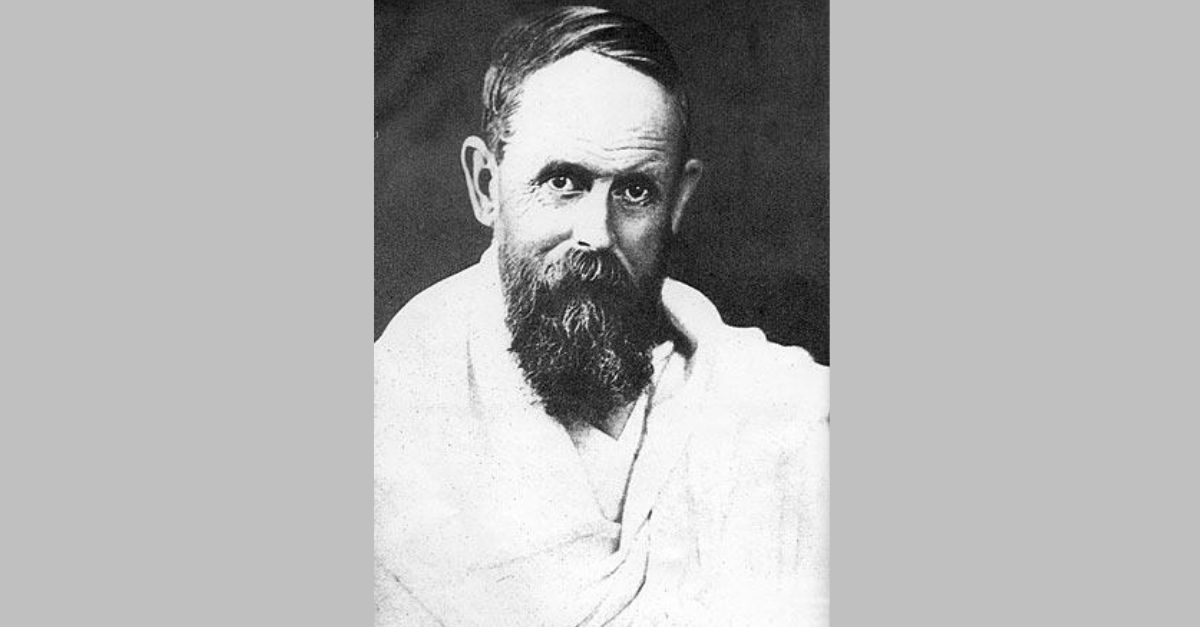

Charles Freer Andrews (1871-1940) was a British Anglican priest, educator and social reformer. He was a graduate from Cambridge and joined St Stephen’s College, Delhi as a teacher when he set foot in India. He guided its affairs for over a decade. While teaching at St Stephen’s College, he developed a liking for Delhi. The city itself became his ‘first love’. Very soon he became a model for a number of people connected with India’s Christian movement.
Andrews got closely associated with its icons like Rabindranath Tagore and MK Gandhi. He empathised with India’s freedom struggle. He felt sorry that he could not serve Aligarh Muslim University during the non-cooperation ferment. This came from his experience of observing racism in Delhi and Shimla. His friends called him ‘Christ’s Faithful Apostle’ and MK Gandhi bestowed him with the title ‘Deenabandhu’, meaning ‘friend of the poor.’ In 1971, government of India issued a postage stamp to commemorate his birth centenary.
Importance of inter-faith dialogue
One of the principal engagements of CF Andrews was learning from peoples of other faiths. He found similarity between the Christ and the Buddha. His readings showed him that the Upanishads and Buddhist texts having much in common with the Gospels. This way, Hindus and Buddhists were like his own people. In 1912–13, Andrews and Principal Susil Kumar Rudra (1861–1925) travelled to England. Both men widened the teaching of religion to include instruction on Hinduism and Islam.
Andrews saw no clear-cut distinction among Christians, Hindus, and Muslims. He found deeper parallels in the basic tenets of all the three aforementioned religions. Andrews believed in an expanded humanism in the Christian approach to Islam and its understanding of Muslim ways. To discover this truth, he suggested reading non-biblical scriptures. In his opinion, just as a Christian would recommend studying the Bible to his Muslim friends, so he may be urged to read and meditate on the Koran. ‘We should rather seek always to see the best in one another,’ he told Gandhi in 1948.
Striving for communal harmony
The time span of CF Andrews overlapped with the rise of communalism in India. His observations and activities deserve special mention. As a keen observer based in Delhi, he talked of ‘a noticeable amalgamation of customs and usages’ among Hindus and Muslims alike as expressions of plurality and composite living. This made him sensitive to the importance of communal harmony. In 1916, he attended Lucknow’s historic meeting that led the Congress and Muslim League to conclude a pact. Andrews was keen to persuade leaders of the two communities to work harmoniously.
This was also the virtue of other two figures of the Delhi Renaissance- Maulvi Zakaullah and Nazir Ahmad. For Andrews, both embraced the inner fundamental truth of all religions and the congruence between Christianity and Islam. According to Nazir Ahmad, Andrews’ Christianity was untroubled by the possibility of antagonism with any other religion. Nazir Ahmad mentioned that the presence of people like Andrews would pave the way for the ultimate level of communal harmony. True it was, as Andrews kept alive the hope of Hindu—Muslim amity till his last.
Lived Islam as understood by Andrews
CF Andrews’s association in Cambridge University with E.G. Browne (1862–1926), a scholar of Persian and Arabic drew him closer to Islam. Browne sensitized the young pupil to the richness of the Arab civilization and its part in quickening Europe’s intellectual life. Andrews read TW Arnold’s scholarly writings on Islam. Arnold critiqued the widespread Christian stereotype of violence as the main reason for the spread of Islam; reaffirmed the tolerant nature of Muslim rule every-where and emphasized the need to differentiate between political and religious persecution.
In Simla, Maulvi Shamsuddin, the Urdu teacher, strengthened his longing to understand Islam’s ‘inner spirit’. In Old Delhi, he spent evenings conversing frankly with the city’s literati, friends and acquaintances in the Muslim localities. He tried seeing from the Islamic point of view. This aided Andrews to understand Indian Islam better. At St Stephen’s College, Maulvis Jamilur Rahman, Abdur Rahman, and Khwaja Abdul Majid stimulated Andrews’ interest in Islam. His interactions with the Muslim students enabled him to understand better, for example, the social, cultural, and economic diversities among Muslims. He enjoyed friendships with Sayyid Ali Imam (1869– 1932), Mukhtar Ahmad Ansari (1880–1936), and Khan Abdul Ghaffar Khan (1890–1988).
Andrews’ Delhi Renaissance
CF Andrews was the one to conceive the theory of a Delhi renaissance. During his first exposure to Delhi, he noticed that Urdu prose was developing, scientific works were being translated into Urdu, and the Urdu printing press was making rapid strides. The writings of Andrews are evenly scattered with references to Sayyid Ahmad, the ‘Erasmus of Delhi’, Zakaullah, ‘a model of true Islamic culture’, and Nazir Ahmad, ‘the greatest of all the learned men of Delhi’. He became aware of an entirely new development in Indian Islam, ‘which eagerly embraces modern science and modern social ideals’, and of the ‘silent changes’ taking place at Aligarh College. He felt that ‘the more thoughtful and progressive’ of its students, with whom he talked, sympathized with the ‘New Islam’. Today, when Andrews is no more with us we can remember him by knowing more about his ‘Delhi Renaissance’.
- This short essay is based on Mushirul Hasan’s book A Moral Reckoning: Muslim Intellectuals in 19th century Delhi (2005, OUP).