
Introduction
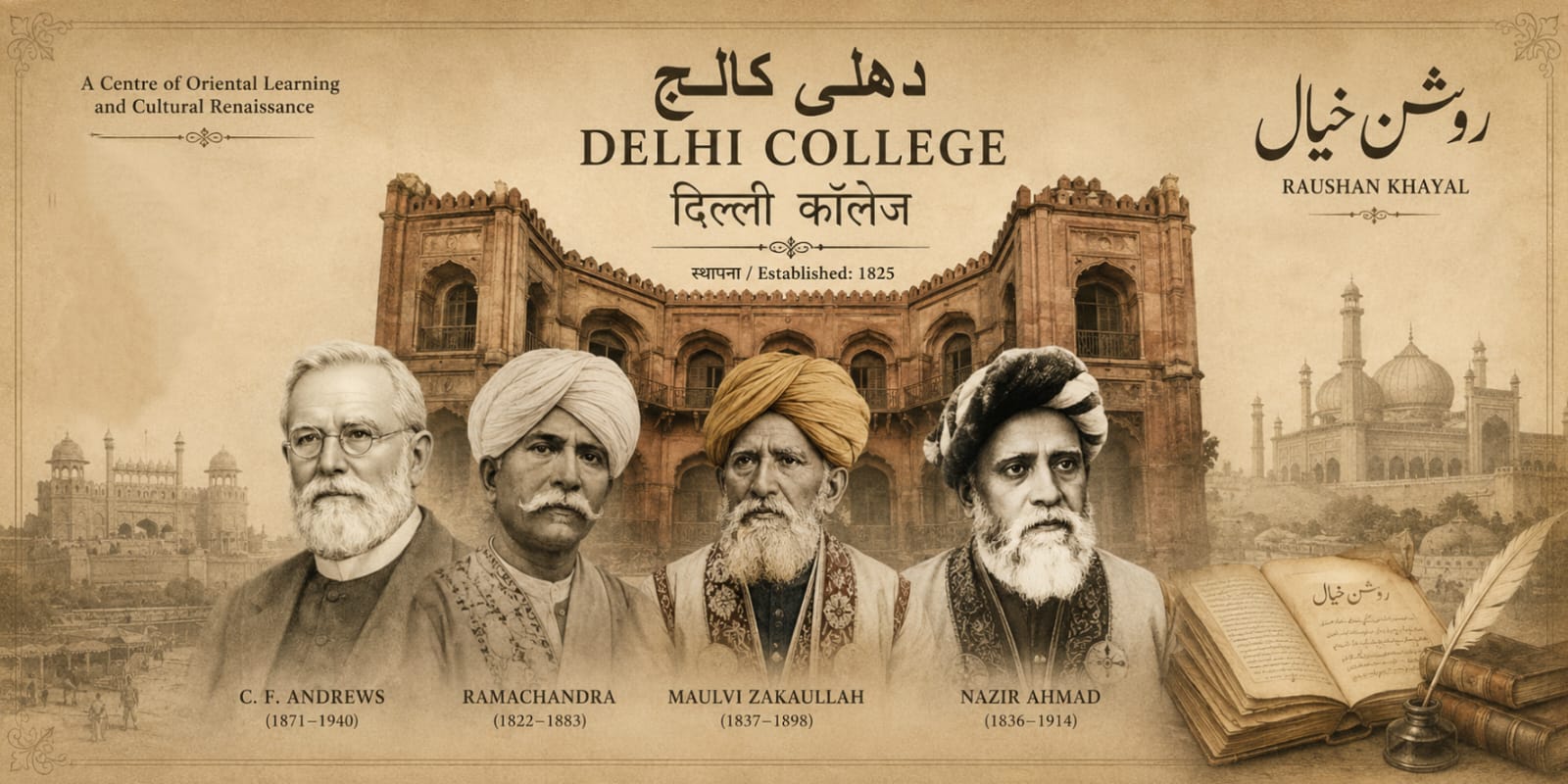
Delhi College was the home of religious and cultural syncretism. It grew out of a St Stephen’s School. In 1881, the college was housed in a rented building in Chandni Chowk. In 1891, it moved into its own buildings at Kashmere Gate. Gandhian CF Andrews had laid its foundation stone in 1939. In 1941, the college occupied its present home in Delhi University. Its career cannot be separated from the city’s intellectual currents. It was during the first half of the nineteenth century that the first stirrings of philosophical and scientific thoughtenlivened its literate, confronting them with questions, which are at the heart of north India’s encounter with the West. The Delhi renaissance suddenly illuminated the age. Colleges in Agra and Banaras vied with Delhi in teaching the new sciences. Andrews believed that this budding movement was of ‘New Learning’. Delhi College was the heart of Delhi Renaissance.
Delhi Renaissance at Delhi College
CF Andrews was the first person to conceptualise ‘Delhi Renaissance’. He writes that Delhi College was the place teeming with intellectuals and thinkers working day in and day out to light the lamp of knowledge; something of this intensity was not seen in the earlier centuries. College managers and teachers agreed that the educational system should be designed to transmit, confirm, and validate the knowledge that they had inherited as well as the dominant ideas that had gained currency under Pax Brittanica. Delhi College and Aligarh College, despite their ambiguities, spearheaded a heterodox movement to foster Western-type schools, and colleges.
Education encompassed not only science, but also knowledge of the morality, religion, history, politics, and philosophy. Teachers and administrators embarked upon changes in the traditional academic curriculum, and created a climate for fostering liberal thought and the rational spirit. The activities at the College led to the confluence of East and West. Students were taught not only Sanskrit, Arabic and Persian but also English. It produced a substantial number of enlightened writers who, in turn, encouraged a simple style of writing as against the bombastic style. The college gifted to Urdu literature what Persian brought into Arabic poetry under the Abbasids in Baghdad (AD 750– 1258). At Delhi, Urdu literature flourished along modern science. Several teachers and students maintained that science and modern knowledge were compatible with the foundation of the Islamic faith.
Intellectual Plurality at Delhi College
One of the defining aspects of Delhi renaissance was ‘intellectual plurality’. Delhi College had opened up a vast range of possibilities for Hindus, Muslims, and Christians to understand each other. The close interaction of students and teachers led to the more pluralistic understanding of north Indian society. We notice an outburst of Urdu translations from Arabic, Persian and English books, both classical works and newer volume on the sciences. Selections from the Ramayana and Mahabharata appeared, along with the diwan of Sauda, Mir Dard, and Shaikh Qalandar Bakhsh Jurat. Along with these were the translated histories of Rome, Greece, England, Persia, and Arabia, and books on political economy that were a part of the curriculum. Whilst translations of Arabic, Persian, and Urdu works were taught, students were also acquainted with English classics. English literature and modern European sciences were taught in the English branch; Arabic, Persian, and Sanskrit, together with geography, mathematics, and sciences in the Oriental section. In 1842, Dilli Kalij had twenty teachers. By 1828, 300 students began studying English. The numbers increased subsequently.
Raushan Khayals (liberal thinkers) of Delhi College
David Lelyveld in his Aligarh’s First Generation writes that men such as Master Ram Chandra and Munshi Zakaullah was pushing forward the Renaissance with painstaking industry, creating a taste for literature, popularizing science— teaching, writing, and lecturing. For Abdul Haq, a renowned biographer, the confluence of East (traditional) and West (modern) that took place in early 19th century north India produced enlightened (raushan khayal) writers and visionaries (balighul nazar) such as Ramchander, Nazir Ahmad, Zakaullah, and Piyare Lal Ashob.
Ramchander joined the Oriental department of Dilli Kalij in 1844. One of the great promoters of modern natural science, he was widely esteemed as a votary of liberal education. His works, especially a treatise on the Problems of Maxima and Minima, were received with a chorus of admiration. His essays on Mathematics were published in Fawaid-ul Nazrin, Mohibb-i Hind, and Qiran-us Sadain. Ramchander produced a monthly magazine that printed notices of English science. His highest achievement was to produce a group of bright students. Zakaullah and Nazir Ahmad entertained a deep veneration for Ramchander. To them, the college atmosphere offered the stimulus they needed to develop their talents.
A Renaissance to be carried forward
Delhi College had become a shadow of its glorious past during the days of CF Andrews. However, Andrews was sensible enough to understand its achievements and legacy in the early 20th century. Historians claim that there were two major reasons behind the sudden collapse of Delhi College and its Renaissance: revolt of 1857 and replacement of Urdu with English.
For CF Andrews Delhi’s Renaissance illuminated an age, but only for a brief moment before it died away. He laments that had it not been blighted by the 1857 Rebellion greater results might have ensued, and it might have been compared in its importance with the Bengal renaissance. Secondly, slowly but gradually Urdu was replaced with English in government transactions. Institutions like Delhi College, lost their raison d’être. By the time a temporary revival occurred from 1864 to 1877, the institution had lost its distinct personality. The merger of the College with Lahore’s Government College in 1877 brought its final end its. Though not physically any more, its legacy must be carried forward. I hope my short essay encourages someone raushan khayal to pursue this endeavour.
- This short essay is based on Mushirul Hasan’s book A Moral Reckoning: Muslim Intellectuals in 19th century Delhi (2005, OUP).