
Introduction
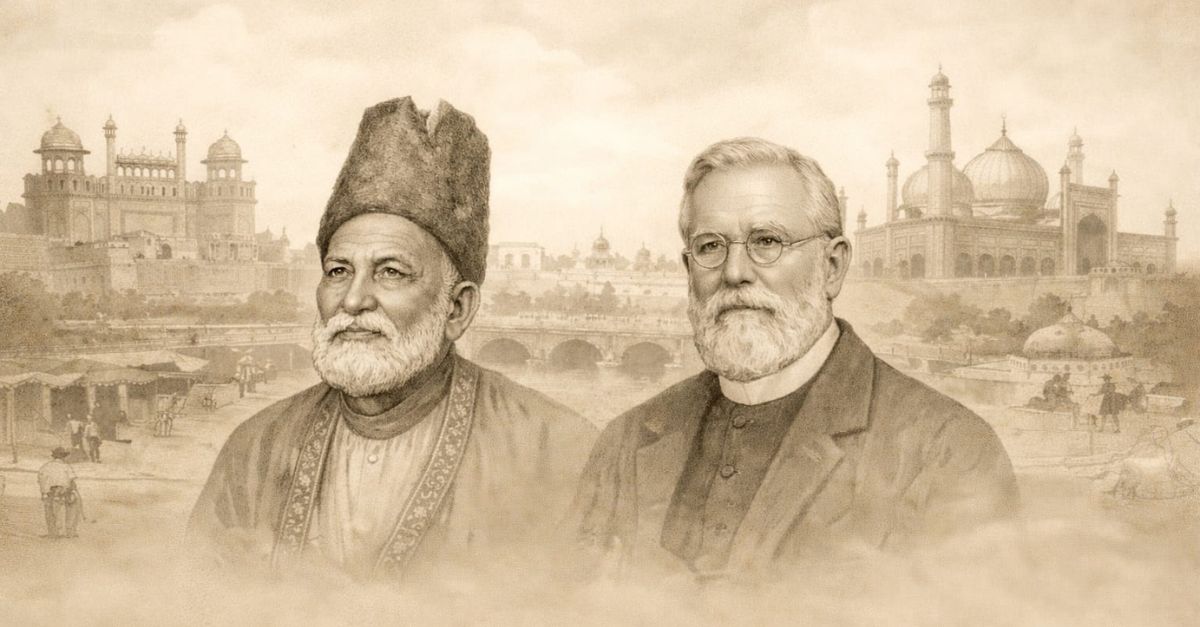
The person who coined the term ‘Delhi renaissance’ was CF Andrews. During his first exposure to Delhi, he noticed that Urdu prose was developing, scientific works were being translated into Urdu, and the Urdu printing press was making rapid strides. Moreover, he became aware of an entirely new development in Indian Islam, ‘which eagerly embraces modern science, and of the ‘silent changes’ taking place at Aligarh College. Andrews found in Delhi ‘the rapid efflorescence of men’s mind’. For him, they epitomized ‘the Renaissance in the north of India,’ and their efforts matched Rammohun Roy’s achievements in Bengal. Scholarship reveals the plethora of books and essays published during the period on philosophy, ethics, law, and in the field of yunani medicine. Delhi had yunani doctors, along with scores of medical practitioners. We know that people read literature on ethics including Akhlaq-i Nasiri (The Nasirean Ethics) by the celebrated astronomer Tusi.
Delhi City
Delhi in the early and mid 19th century was a vibrant cultural and intellectual hub, something which was not there in north India, at least in this intensity. Delhi had its share of learned scholars, witty writers, and skilled poets. This walled city offered the site of those active and distinguished discussions and investigations that later fructified in the establishment of Dilli Kalij in 1825. As the mulla makes for the masjid, so scholars flocked to Delhi,’ remarked Maulvi Karimuddin (1821–79), who came from Panipat and, in 1840, joined Delhi College and soon became a prominent intellectual. Delhi College was the heart of Delhi renaissance. This was the Delhi with its historians, economists, poets, writers, and journalists.
Intellectuals
Ramchander, Piyare Lal Ashob, Sayyid Ahmad, Zakaullah, and Nazir Ahmad served as exemplars of the Delhi renaissance. So did Ghalib and Hali. Not to deny, their paths intersected and diverged in significant ways. All of them had an acute sense of their own historical context. Self-conscious about the legacies they had inherited, they approached other intellectual traditions with the intention of learning from them. Felix Boutrous, Principal of Delhi College, founded the Delhi Vernacular Translation Society in the early 1840s. One of the luminaries of the College was Master Ramchander (1821–80) who taught science and mathematics. Every evening, Zakaullah, Nazir Ahmad, and Piyare Lal ‘Ashob’ (1838–1914), gathered at the Public Library.
Poetry
It was more or less customary among the Dilliwalas to recite Urdu and Persian verses and quote from the Koran and Hadis (Traditions of the Prophet). Educated persons, in particular, flaunted their appreciation and understanding of poetry. The practice of quoting poetry at public platforms was widely prevalent. Individuals and local literary associations, re-kindled the enthusiasm for literature. The Urdu translation of Gulistan (The Rose Garden) by 13th century Persian poet Saadi, was printed in Nastaliq script in 1809. The last quarter of the nineteenth century witnessed an extraordinary growth of social, and educational associations among Muslims. They were located in Calcutta, Lahore, Delhi, and Lucknow. For the speaker the venue itself assumed importance for building up a public reputation; a speech in Lahore meant coverage in the Tribune and the Civil and Military Gazette, while a decent selection of verses won the literati’s acclaim. Public address has been a mode of communication in which the members of a public recognize the plurality of groups and perspectives that constitute it. Hence, people travelled from faraway places to see and listen to their icons. Nazir Ahmad especially mentions Zauq, Momin, Ghalib, Dabir, and Anis.
Prose
Present-day Urdu prose or the ‘new style’ originated in Delhi. We can see this simple style in the writings of Ghalib, Sayyid Ahmad, and Muhammad Husain Azad. Mohsinul Mulk (1837–1907), Sayyid Ahmad’s close associate, used Urdu prose with great effect to expound the changes Islam was accepting slowly but gradually with the political and social transformation.
Newspapers
Slowly but steadily proliferated the publication of pamphlets, newspapers, and magazines. The lithographic press facilitated both the publication and accessibility of Urdu newspapers. The circulation of newspapers increased enormously. Dehli Urdu Akhbar, edited by Maulvi Muhammad Baqar (1810–57), came out in 1841. Comrade, the influential English daily, moved from Calcutta to Delhi. Its managers were none other than Muhammad Ali and his elder brother, Shaukat Ali (1873–1938). Such newspapers, besides forming the pool from which administrators drew their information, were the product of ‘mutual encounters which led to a multiple intertwining of the self and other, the indigenous and the colonial, the traditional and the modern.
Lived Islam in Colonial India
A spirit of intensive respect for the religious beliefs of every other community dominated the thinking of Zakaullah, Nazir Ahmad, and Sayyid Ahmad. Liberal humanism forged a place for itself in Urdu literature produced mostly at Delhi College. Although Fawaidul Nazirin, Qiranul Sadain, and Mufid Hind catered to an educated élite, they helped mould social opinion by sponsoring translations of the Koran and Hadis, and reissuing classical works and moderately priced dictionaries. In the first quarter of the twentieth century, to redress the imbalance of secular education, an academy (Nazarat-ul-Maariful-Korania) at Delhi’s Fatehpuri mosque made provision for teaching the Koran to the English-educated Muslims. It seemed a major step down the road which Ajmal Khan and Ubaidullah Sindhi pioneered. The foundation of Jamiyat al-Ansar in 1901 was a further straw in the wind to foster fraternal links between Deoband and Aligarh’s alumni.
Conclusion
Almost a century ago, CF Andrews wrote about ‘Delhi Renaissance’. Yet, not much has been written and propagated in this direction. A speech on the indigenous roots of colonial modernity (2023) by Swapna Liddle and a book Muslim Enlightened Thought (2025) by Ayesha Jalal are two exceptions. It is high time, young scholars take forward in writing the intellectual history of India’s Muslims. My short essay is a small step in that direction.
- This short essay is based on Mushirul Hasan’s book A Moral Reckoning: Muslim Intellectuals in 19th century Delhi (2005, OUP).