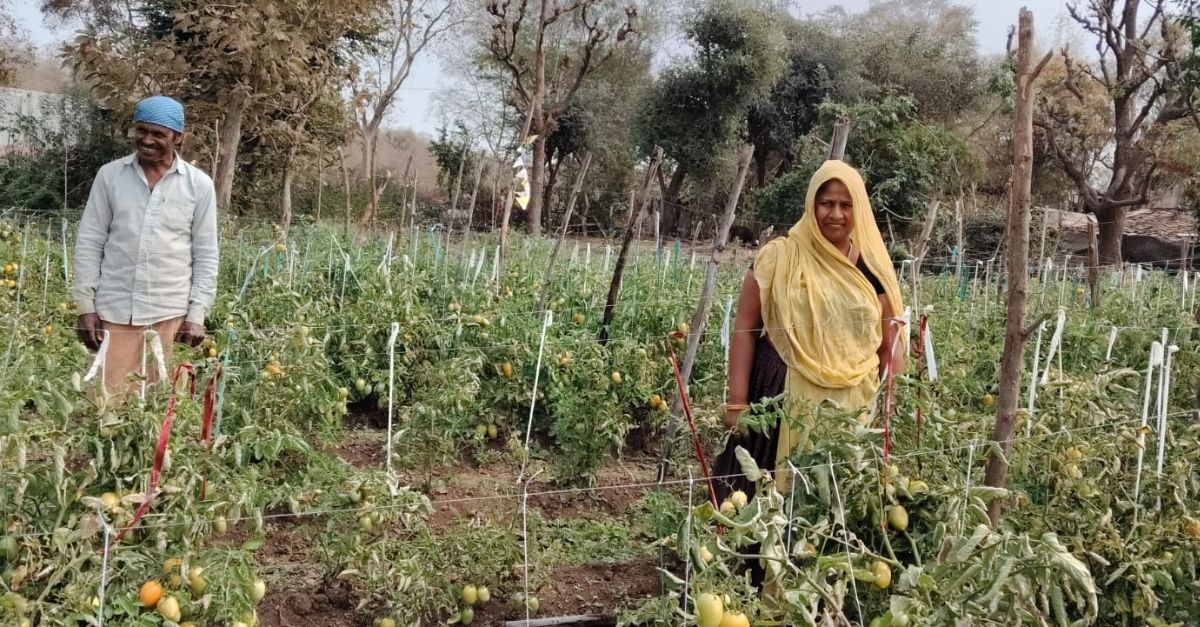

In the small village of Kundli, under Rajia Panchayat in Ghatol tehsil of Banswara district, Rajasthan begins the story of a tribal family 43-year-old Vanta Ramdas Charpota. Despite facing repeated failures, she never gave up. With hard work, dedication, and improved agricultural techniques, she transformed her land into a field of hope.
Vanta Devi’s life was like that of many tribal women—spent between the farm, home, and family. She had a dream: one day, she would bring prosperity to her family. To meet daily needs, she used to grow only vegetables on her land. Her farming was for subsistence, not for business.
One day, while visiting her parental home, she saw a lush green field filled with bright red tomatoes along the way. That sight sparked a thought if that farmer could grow such a good crop, why couldn’t she? In that moment, a dream was born in her eyes: a dream of her own field full of produce, providing nutritious food and a stable livelihood for her family. Upon returning home, she decided to cultivate tomatoes. However, she had enthusiasm but lacked technical knowledge. She did not know about soil testing, proper irrigation methods, or the correct use of fertilizers. She invested her savings and worked tirelessly, but the results were disappointing. The crop did grow, but the yield was far below expectations.
Around that time, Vaagdhara organization had started its activities in her village. Vaagdhara works in the tribal regions of southern Rajasthan to empower women, promote sustainable farming, and strengthen livelihoods. Community facilitators Mukesh Maida and Kaluram Ninama formed a capable women’s group in the village and encouraged Vanta Devi to join, even giving her leadership opportunities.
After joining the group, she received training under the “True Farming” program through Farmer Field Schools. This training was practical and hands-on. She first learned the importance of maintaining soil moisture and the effectiveness of drip irrigation. She learned how to use water efficiently and economically.
However, the most important learning was the method of preparing advanced natural compost (Ukda compost). Vanta Devi had three buffaloes, two oxen, one cow, and six goats. While these animals had always been her economic support, she had not fully utilized their dung and waste. Vaagdhara taught her that everything she already had—animal dung, dry leaves, crop residues, twigs, and other organic materials—could be transformed into a powerful and highly useful fertilizer. This would not only enrich her soil but also reduce her dependence on expensive chemical fertilizers.
The method of making Ukda compost is not new; it is deeply rooted in traditional agricultural practices. For centuries, our ancestors have considered cow dung sacred and useful. This reflects the deep connection between livestock and nature. What Vanta Devi learned was a scientific refinement of this traditional knowledge.
The process of preparing this compost is systematic. First, a pit is prepared at a suitable location, preferably on higher ground to avoid waterlogging. Animal dung, urine, dry leaves, crop residues, and other organic materials are collected in this pit.
Then, about 5 to 10 kilograms of rock phosphate per ton is added to increase phosphorus content, which is essential for root development and overall plant growth. Bio-fertilizers containing beneficial microorganisms are then sprinkled over the mixture. These microbes help decompose organic matter quickly and enrich the compost. The heap is covered with grass or organic material (not soil) to allow air circulation. Maintaining moisture is crucial, so water is sprinkled periodically.
Every 15–20 days, the compost is turned with a spade to ensure aeration and microbial activity. After about 60–90 days, the compost turns dark brown and emits an earthy smell, indicating that it is ready.
Vanta Devi carefully learned this method and applied it on her farm. She collected dung, dry leaves, and crop residues. With sufficient livestock at home, raw materials were readily available. She prepared a pit and followed the entire process. After two to two-and-a-half months, when the compost was ready—dark brown and rich with the scent of fresh soil—she felt immense joy and excitement. This time, she decided to grow tomatoes again, but now she was prepared. On her 0.25-acre land, she used about one quintal of Ukda compost. She adopted drip irrigation, prepared seedlings in a nursery, and transplanted them into the field. She maintained soil moisture, performed timely weeding, and closely monitored the crop.
This time, her hard work and knowledge came together, and the result was remarkable. From just a quarter acre, she produced 2,500 kilograms of tomatoes. She sold them at ₹25 per kilogram, earning over ₹62,500. Additionally, she earned ₹10,000 from brinjal cultivation and ₹8,000 from spinach, fenugreek, and coriander. She also prepared tomato seedlings for the next season, showing her foresight and planning skills. Altogether, her total income from farming that year exceeded ₹82,000.But this success was not just about numbers.
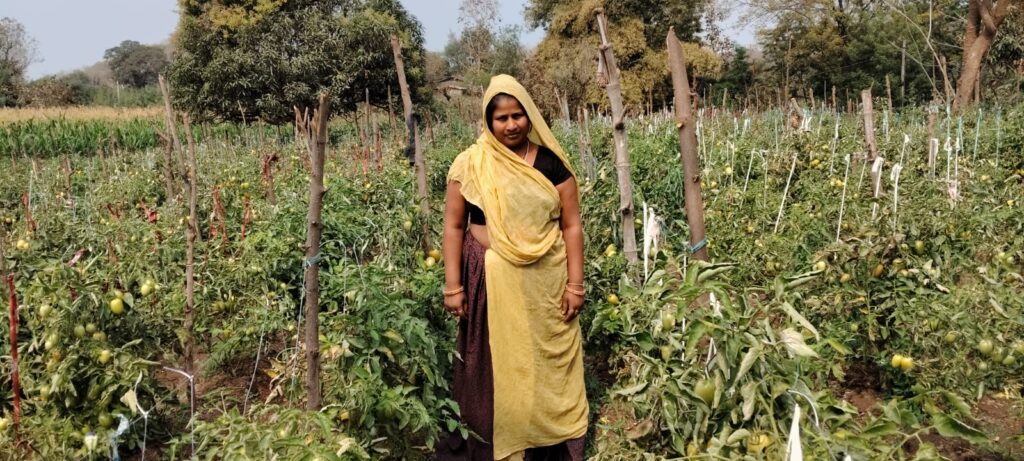
With increased income, her household transformed. Nutritious food became a part of daily life. The family was freed from the uncertainty of wage labor. Farming became a source of dignity, self-respect, and self-reliance—her true identity.
Vanta Ramdas Charpota’s journey is significant because it shows that failure is not the end. Her initial loss in tomato farming could have discouraged her completely, but instead, she treated it as a learning opportunity. With the right guidance, techniques, and organizational support, she adopted new practices with dedication.Vaagdhara and its “True Farming” program played a crucial role in this journey.
The organization not only provided technical training but also created a collective platform where women could learn from and support each other. The capable women’s group became a space where women like Vanta Devi could share challenges and find solutions together. This sense of collective strength is the foundation of sustainable change.
Today, Vanta Devi stands as a living example for all women in her village who aspire to build a better life through their land, livestock, and hard work. Her success proves that even small landholdings can be profitable if supported by the right knowledge, techniques, and determination.
Her story is a harvest grown from the soil of Banswara’s tribal region—not just of tomatoes, but of hope, dignity, and transformation. The seeds she has sown are not only growing in her field but also in the hearts of countless women around her who dream of a better future.