
In the tribal regions of Rajasthan, Madhya Pradesh and Gujarat, farming has never been merely the act of growing grain. It has been an entire philosophy of living, an unbroken web of relationships binding water, forest, land, animals, seed, labour and food together. On the fields of these farming families, pulses such as moong (green gram), chana and urad (black gram) were grown, and the first claim on the harvest belonged to the family’s plate, not to the market. At home, women would process these pulses on a stone grinder known locally as the “ghatti”. This was never just a method of preparing food; it was a tradition of local knowledge that travelled forward through the hands of women, generation after generation. The ghatti stood as a living symbol of food sovereignty.
But time turned a corner. With the wave of modernization came the spread of mechanised processing, and market demands redirected the course of farming itself. Pulses, once the backbone of household nutrition, were transformed into a cash crop. The dal grown in the fields now travelled to the mandis rather than to the kitchen. The central role that women once played, from growing the crop to processing it, gradually slipped to the margins. It was to fill this very void that Vaagdhara, the Krishi evam Adivasi Swaraj Sangathan, and the Mahi Mahila Kisan Manch came together for an extraordinary initiative: the Dal Utsav, or Pulses Festival. The name is simple, but the spirit behind it runs far deeper, a resolve to revive a heritage that belongs to the tribal community.
The message of the Dal Utsav was unambiguous: the first right over a crop grown in the field must rest with the nourishment of the family, not with the market. This is the very soul of food sovereignty. And no one understood this message more deeply than the women themselves, those who for decades had watched the fruit of their own labour pass into other hands.
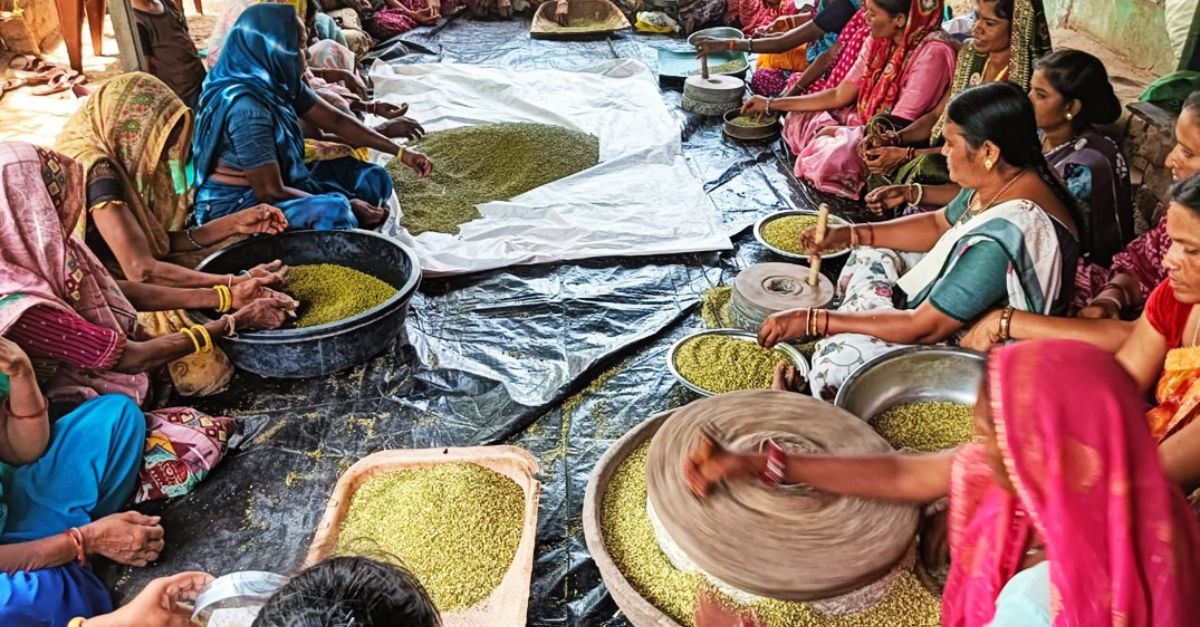
The festival was organized across several blocks and its echo travelled far and wide. In villages such as Chhoti Badwas, Amlipada, Biluda, Jetpura, Matiya, Tamtiya, Vanda, Ganeshpura, Raipura, Nani Dhadheli, Bijor and Mahapura Rathore, women arrived carrying moong and other pulses grown in their own fields. They came not simply to prepare dal, but to rediscover their own identity. They took hold of the ghatti, turned it, and brought back to life an entire process that lived in the memory of their mothers and grandmothers. In all, 1,398 women took active part in the festival, and their participation was itself an expression of collective awakening.
Hundreds of women sat together, hands on the grinder, conversations flowing, experiences being exchanged, and dal being prepared all at once. The patience, the rhythm and the ease that turning a ghatti demands were all alive that day in their hands. Older women guided the younger ones, the young women learned simply by watching, and children, witnessing it all, found themselves connected once again to their cultural roots. This is exactly what the living transfer of traditional knowledge looks like.
The outcome of the festival was not only spiritual but tangible. Through collective labour, nearly 2,868 kilograms of dal were prepared by traditional methods. Alongside this, 131 kilograms of dal churi and 49 kilograms of husk were also produced, both of which found use in animal husbandry and household needs. Of the dal produced, 497 kilograms were sold, while the women carried the rest home for their own families. Given prevailing market prices for pulses, the savings this brought to these households were considerable, and the money that would otherwise have gone toward buying dal became available for other family needs.
Viewed economically, the Dal Utsav opened up an entirely new possibility for women. In tribal regions, women pour their full effort into farming, yet their labour is rarely given economic recognition. They produce, but the value of that produce usually reaches them only through men or through the market. The Dal Utsav broke this chain. When women processed the dal themselves, the experience stirred a new awareness within them, one that signals the far-reaching impact this initiative may yet have.
From the standpoint of nutrition too, the festival proved deeply significant. Malnutrition, anaemia and protein deficiency remain serious challenges across tribal regions even today. Pulses are among the cheapest and most accessible sources of protein, yet when they reach the household only by way of the market, that access becomes limited. The Dal Utsav closed this gap. Pure, fresh, local dal reached families directly, dal that had passed through no chemical processing and carried no stamp of a large mill, but instead bore the touch of a farmer woman’s hands and the fragrance of the soil of her own field. The women themselves said that the difference between dal made at home and dal bought in the market lies not only in taste, but in trust as well.
The Dal Utsav also brought into focus a dimension of food security that policymakers often overlook: food diversity. At a time when global food systems are becoming increasingly dependent on a narrow handful of crops, the conservation and use of local pulses emerges as a deep ecological and social necessity. The Dal Utsav gave this necessity the form of a community celebration.
The festival also places a larger question before us: what does development actually mean? Does development consist only of large factories, machines and technologies? Or is development also something that begins the moment these women take hold of the ghatti and ends only when it reaches their family’s plate? The Dal Utsav demonstrated that the most sustainable development is one built upon local resources, traditional knowledge and community participation. It requires no outside expert, only the knowledge of the women who have carried out this work for centuries.
This initiative of the Mahi Mahila Kisan Manch also showed that platforms are most effective when they recognise a community’s own strength and give it a stage, working alongside people rather than doing things for them. In this programme, women were not merely present; they were the organisers, and they were the producers. It is precisely this coming together of roles that offers the truest definition of women’s leadership.
In an era marked by the triple challenge of climate change, market instability and malnutrition, initiatives like the Dal Utsav point toward an alternative path, one of self-reliance, of cultural pride, and of the collective wisdom concealed in the lines of a tribal woman’s hands. The resolve shown by 1,398 women, the 1,515 kilograms of dal this effort yielded, and the nourishment that reached hundreds of families together lay the foundation for a future in which food sovereignty will be not merely a slogan, but the lived reality of everyday life