
Gulha-i rang rang se hai raunaq-i chaman
Ai Zauq is jahaan ko hai zeb ikhtilaaf se.
Lived Islam in India was always pluralistic in its orientation, which means Islam as lived by Muslims always existed side by side with Hinduism, Christianity, Jainism and other religions. Like most religions, Islam also had its own set of differences. We get to see that in the nineteenth- century north India, two opposite currents were running. One claimed itself to be ‘high tradition’ and universal while the other ‘little tradition’ and regional. But these were not neat and clean opposite binary. For even the ‘high’ tradition varied with time and place, from school to school, and from scholar to scholar. ‘Little’ tradition itself oscillated between universal and local meanings and practices. This dialectics between the ‘high’ and ‘little’ traditions as well as ‘sacred’ and ‘secular’ spaces was a part and parcel of the Islamic tradition itself.
Mushirul Hasan argues how Islamic practices and thought were never monolithic and always improving through dialogue and discussions over time. This way he breaks down the ‘Orientalist’ assumptions about Islam and the unreflective presumptions about Muslim societies. He also laments on how very few have seriously undertaken the study of Muhammad Iqbal’s The Reconstruction of Religious Thought in Islam (1930).
Inter-faith dialogue: Global perspective
Since the advent of Islam, Muslims have been conscious of the religious diversity of human race. An entire literary genre, known in Arabic as al-Milal wa al-Nihal, has developed since the eleventh century to study religions like Judaism and Christianity. Hasan mentions number of scholars who endeavoured to study Islam without fear or favour, like The Dictionary of Islam (1885) compiled by TP Hugnes, On Understanding Islam (1981) and Islam in Modern History (1957) by WC Smith, Approaches to Islam in Religious Studies (2001) edited by Richard C. Martin, Islam, Europe and Empire (1966) by Norman Daniel, and Muslim Perceptions of Other Religions (1999) edited by J. Waardenburg.
In similar vein, we find The Call of the Minaret (1956), A Common Prayer (1999) and The Pen and the Faith (1985) by Kenneth Cragg, the Anglican Bishop of Jerusalem, portraying Islam in a deeply sensitive way. He highlighted the importance of dialogue between Muslims and Christians. There were other important interventions by Geoffrey Parrinder (Jesus in the Quran), Marc Gopin (Holy War, Holy Peace) and J.N. Hollister. Despite this, most thinkers failed to understand this complexity and continued with their shallow understanding of Islam as a faith that was incompatible with humane values.
Inter-faith dialogue: Indian perspective
Inter-faith dialogue among intellectuals has always been the hallmark of the lived Islam in north India. There are signs of Christian–Muslim dialogue taking place between TW Arnold and Shibli Numani. It was TW Arnold who spoke at the Muhammadan Educational Conference in 1890 on the ‘peaceful’ spread of Islam in China and Java. He wrote The Preaching of Islam: A history of the propagation of the Muslim Faith (1896). Similarly, Indian Islam (1959) by Murray Titus and Abul Kalam Azad (1988) by Ian Henderson Douglas highlighted that Islam was a dynamic religion, a living faith.
Here in India, similar results were observed in various scholarly studies. ‘Indian Islam’, wrote Percival Spear (1967), ‘is a necklace of racial, cultural, and political pearls strung on the thread of religion’, and that one cannot appreciate the necklace merely by studying the thread. Most of the scholars of the 19th century India maintained that true Islam teaches virtues, reason, and equality. One of the best examples is of Sufism. Islam, science, and progress were all compatible. We see evidence of this in Delhi, especially in response to the advent of the colonial system.
Lucknow-based Abdul Halim Sharar detailed the historical relations between the Muslim and Christian communities. Maulana Azad came to believe in the oneness of all religions, an idea expounded in the two volumes of his Tarjuman al-Koran. Syed Ameer Ali wrote The Spirit of Islam (1891). Mohammad Ali argued that the main theme of Muhammad and Jesus was identical. Khwaja Hasan Nizami published Tarikh-i Masih (Life of Jesus) in 1926. He intended to acquaint Muslim children with Christianity and wanted them to know about the prophets and preachers of different religions. He believed that the knowledge thus generated would promote communal harmony.
Living in a pluralist society: Delhi in the 19th century
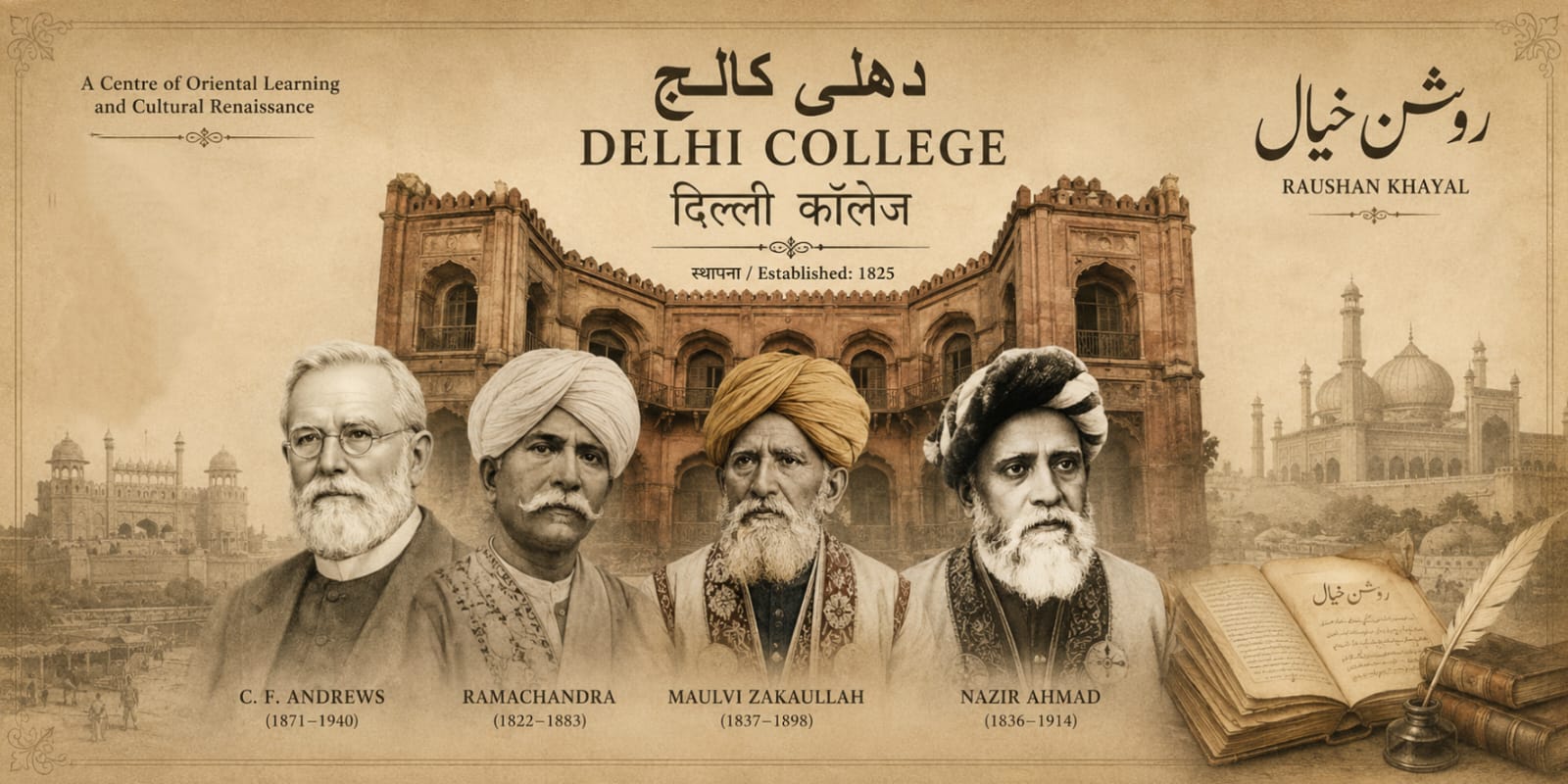
The nineteenth-century Delhi was, for the most part, a time of cultural synthesis where most people went along quietly about their business. Religious identities were neither monolithic nor universal. People made sense of their world through a wide array of networks consisting of family, kinship, occupation, neighbourhood, locality, township and language. This was the main reason why Delhi was not merely an urban space but equally a culturally thriving milieu. All the major figures of the ‘Delhi Renaissance’– Sayyid Ahmad, Munshi Zakaullah, Nazir Ahmad, and Mirza Ghalib– lived in this Delhi. They found wisdom in numerous religious traditions, and built bridges of mutual understanding and respect. While adhering to the personality paradigm of the Prophet, they drew on non-Muslim religious figures in order to develop a conception of coexistence among different religions. Those were the times when people read and learned from the Persian works of Nasiruddin Tusi.
The Phoolwalon ki Sair and the Pankha festival (Festival of Flowers and Fans) were started during the reign of Akbar Shah II (1806–37). Both attested to Islam’s assimilative character and illustrated that Muslims shared responsibility with people of other faiths. Farhatullah Beg, well known for his fictional account of Delhi’s mushaira (assembly of poets) in 1845, vividly wrote: ‘Pankha festival brought together the … people from all religions, castes and communities.’ The last Mughal emperor celebrated Holi at Mehrauli. Bahadur Shah became an apt symbol, in 1857 in whose reign Hindus and Muslims were ‘tied into one political unit by the social perception of Hindustan as one land.’
When we look back we find pluralism, not majoritarianism, was the dominant culture. People not only lived despite differences, but also cherished it. Faith was not a source of social or even political conflict. Lived Islam in India cherished inclusivity and diversity. In such case, our task is to learn from the past.
- This short essay is based on Mushirul Hasan’s book A Moral Reckoning: Muslim Intellectuals in Nineteenth- century Delhi (2005, OUP).