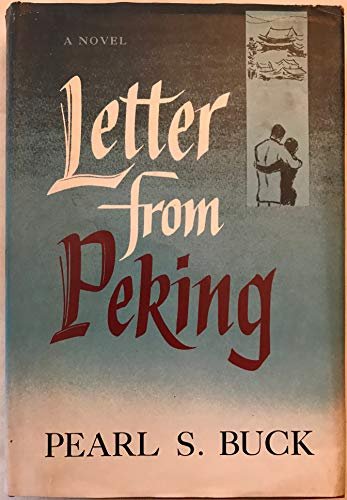

Some books are read and forgotten after a few days. Some books remain in our minds for years. Letter from Peking (1957) by Pearl S. Buck is a book that, for me, belongs to the second kind. I loved this novel very much because it is full of love, human relationships, emotions and small incidents from everyday life. While reading it, I often felt that I was not simply reading a novel but watching a beautiful film in front of my eyes.
Buck has a special ability to describe ordinary life in a beautiful way. The small incidents, conversations, habits and feelings of the characters are presented naturally. There is no need for every incident to be dramatic. Even a simple conversation or a small change in a person’s behaviour becomes meaningful. This is what makes the novel so close to real life.
The novel is particularly beautiful in its treatment of love. There is the love between husband and wife, the love between parents and children, the love of young people and the affection that develops between members of a family. At the same time, the novel does not present human relationships as perfect. Love can bring happiness, but it can also bring pain, misunderstanding and separation. There are moments of love and moments of hatred, and this makes the relationships believable.
One of the things I particularly enjoyed is the way the good qualities of the characters are described. The characters are not presented through big events. Their nature is revealed through small actions and everyday behaviour. At the same time, there are exceptional situations that show another side of human nature. These small details make the characters appear like real people whom we could meet in our own lives.
The teenage and youthful experiences in the novel are also narrated with great beauty. The feelings of young people are shown without making them unnecessarily artificial. The reader can understand their happiness, confusion and emotional struggles. These portions reminded me that love at a young age can remain deeply connected with memory even after many years.
The relationship between Rennie and her family is another important part of the novel. Rennie is not simply a character moving through the story; through her experiences, we see questions about family, belonging and identity. Her relationships with different people reveal the complicated nature of love and responsibility.
I was especially interested in some of the small incidents involving the people around Rennie. Even a statement made by a young woman connected with Rennie becomes memorable because it reveals something about the characters. Such moments may appear small when separated from the novel, but within the story they become important. This is one of the strengths of Pearl S. Buck’s narration. She knows how to make an ordinary incident stay in the reader’s memory.
The novel also takes us beyond individual relationships and brings us to the relationship between nations. The personal lives of the characters are affected by political circumstances and the conflict between countries. This is one of the most interesting aspects of the novel for me. A political conflict may begin between governments or nations, but its effects finally reach ordinary families. People who have nothing to do with political decisions may have to live with separation, uncertainty and emotional suffering.
Letter from Peking shows how history can enter a family home. Political boundaries cannot separate people who love one another. A husband and wife may belong to different countries, yet their feelings for one another do not disappear because of a political boundary.
Elizabeth is another character whose inner world is presented with great sensitivity. Her dreams and thoughts add another dimension to the narrative. I particularly remember the description of Elizabeth’s dream at midnight. The dream is narrated so beautifully that it creates a strong visual impression in the mind of the reader. It is one of those passages where the atmosphere of the novel becomes almost cinematic.
The grandfather of Rennie is another memorable presence. His character adds the experience of age, memory and family history to the novel. Through older people, the novel reminds us that family is not only about the present generation. Every family carries memories from the past, and the elderly members of a family are often the people who preserve those memories.
There are also beautiful descriptions of nature. One of the images that stayed with me is the music coming from the mountain hills during the night. Such descriptions create an atmosphere around the characters and their emotions. While reading, I could almost hear that distant music and imagine the quiet night.
The title ‘Letter from Peking’ itself is meaningful because letters become a way of maintaining a connection across distance. When people cannot be together physically, words become a bridge between them. In the novel, communication is closely connected with love, memory, separation and hope. The letter is not merely an object; it represents a relationship that continues despite physical and political distance.
Another quality I admire in the novel is its humanity. Although the story is connected with China, America, political circumstances and cultural differences, the emotions at its centre are universal. People everywhere experience love, loneliness, family attachment, jealousy, hope, fear and separation. A reader does not need to belong to the same country or culture as the characters to understand these feelings.
The novel also made me think about ageing and responsibility within families. The relationship between younger and older generations is treated with warmth. The elderly are not simply background characters. Their presence reminds us of family responsibility, memory and the passage of time. In a rapidly changing world, these relationships remain important.
At times, the novel presents differences between Eastern and Western societies and a modern reader may look at these descriptions with some doubts. Yet this does not take away from the emotional power of the novel. Rather, it gives contemporary readers another reason to think about how literature represents different cultures and relationships.
For me, Letter from Peking by Pearl S. Buck is ultimately a novel about people. It is about the desire to love and to be loved, the pain of separation, the strength of family relationships and the way history can enter the most private areas of human life. It combines teenage love, husband-and-wife love, family affection, national conflict, dreams, memories and the quiet beauty of everyday life.
There are many novels in the world, but only a few create the feeling that we have actually lived with their characters. Letter from Peking by Pearl S. Buck gave me that feeling. I could see the characters, hear their conversations and imagine the places described by the author. Some scenes remain in my mind almost like scenes from a film. Reading it was, in many ways, like watching a beautiful cinema made with words.