
Introduction
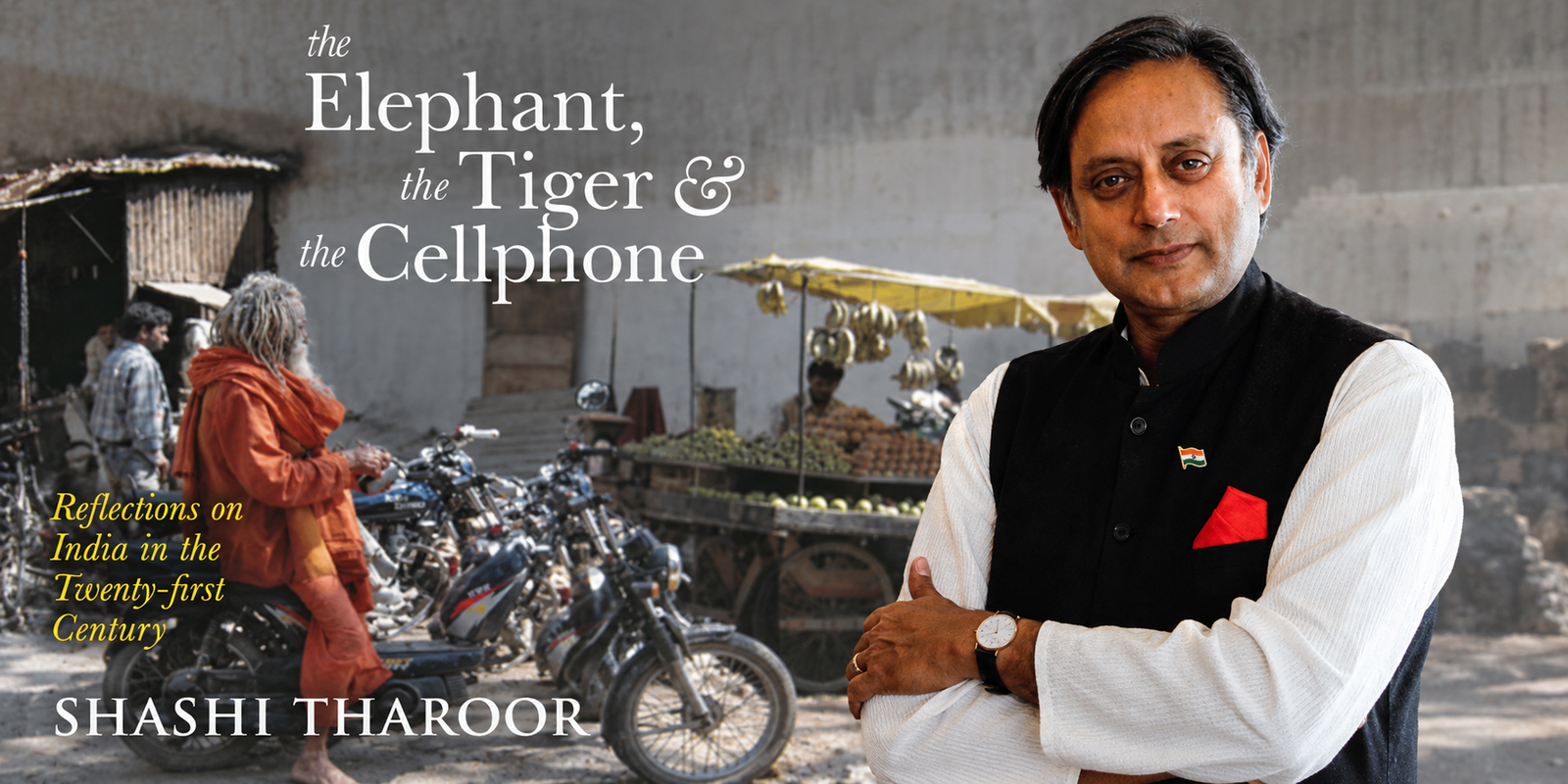
The Elephant, The Tiger and The Cellphone (2007) by Shashi Tharoor is a collection of around seventy essays mostly written as newspaper columns from the turn of the 21st century till late 2006. Their common theme is the assessment of the past sixty years of India’s independence (1947-2007) and a search for a brighter future.
Brief overview
Here ‘elephant’ denotes India’s mighty but sluggish economy, ‘tiger’ denotes a fast paced newly liberalised economy and ‘cell phone’ is symbolic of the economic changes happening after India adopted LPG (liberalisation, privatisation and globalisation) policies after 1991. Till then it was a mixed economy. This book is concerned about poverty, illiteracy, regional imbalance, class inequality, caste hierarchy, patriarchy, majoritarianism, cricket, books, movies and paintings. The book tries to capture the paradoxical nature of India in an optimistic way. One of its best features is its unconditional support for religious pluralism. Chapters 16 to 21 are my favourite. They unravel major challenges in front of India, the idea of India as envisaged during Freedom Struggle, inclusivity of Hinduism, majoritarianism masquerading as nationalism, and finally discrimination faced by India’s Muslims and Christians.
Personal journey
This book has sections on his tender relationship with his father, his childhood in Mumbai, Kolkata and Delhi, annual visits to his ancestral village in Kerala with his parents, his penchant for cricket, his dismay at changing names of places and some pensive times of losing one’s close friends.
Human development
Tharoor acknowledges that south Asia is one of the poorest regions in the world and India is also a part of it. India faces the challenges of poverty and illiteracy at a level which is unacceptable despite ‘green’ and ‘white’ revolutions. All through the book he vouches for social and economic development.
Pluralism
One of the biggest strengths of this book is the pointing out of pluralism as a value and a fact. Our national identity is ‘unity in diversity’ not homogeneity. It is a country ‘where the wail of the muezzin routinely blends with the chant of mantras at the temple, and where the tinkling of church bells accompanies the gurdwara’s reading of verses from the Guru Granth Sahib.’
Freedom struggle
We know India was born after anti-colonial struggle. Its leaders and their dreams are our guiding light. This book has chapters on Gandhi, Nehru, Patel and Azad. Gandhi inspired leaders across the world for non-violence, Nehru became a beacon of socialism, scientific temper and non-alignment, and Maulana Azad became a role model of Islamic pluralism. Like Rafi Ahmed Kidwai and Saifuddin Kitchlew, Azad opposed the Partition.
Hinduism
If support for pluralism is the best aspect of the book, its understanding of Hinduism is the second best aspect. Tharoor strongly argues that Hinduism allows sharing of space, thought and cultures across religions. He claims this as a believing Hindu and says a majority of Hindus ‘pride themselves on belonging to the only major religion in the world that does not claim to be the only true religion’.
Islam
Similarly, the book argues that Islam in India is pluralistic. In the case of South Asia, Islam and Hinduism have co-existed for centuries. Islam arrived in India through sea trade routes and Kerala was one of the earliest places to welcome it. Persian was the court language during medieval times, and it got percolated down from ruling elites to professional classes. Few people know that the Cabinet Mission Plan of 1946 was accepted by the Muslim League. Acharya Vinoba Bhave compiled The Essentials of the Quran. The book also mentions the scholar of Islamic history, WC Smith.
Women empowerment
The book has taken women and development seriously. ‘A woman empowered is a family empowered’. An educated girl tends to become an asset for society– skilled workforce, aware citizen, and a conscious mother. Giving example from Kerala, Tharoor shows how rural micro-credit system as designed by Muhammad Yunus’ Grameen Bank has been adopted in Kerala and showed remarkable results. Women have shown their worth whenever given due opportunity.
Inspirational figures
Nehru, Gandhi, Azad and Patel were four inspirations from the freedom struggle. Tharoor admires Dr Ambedkar and Amartya Sen. Ambedkar wanted not only political freedom but also social freedom. He demanded minority rights for Dalits. After Independence, he became Buddhist. His framing of Constitution is considered as a masterpiece. Tharoor’s admiration for Amartya Sen is unconcealed. Staunch believer in the idea of democracy, Sen laments that India is struggling with majoritarianism.
A book reviewed
Today, we have enough scholars who have already shown that most communal violence is engineered by political leaders. They peddle rumour and provoke common men to take weapons in their hands. Tharoor has reviewed Ashutosh Varshney’s Ethnic Conflict and Civil Life: Hindus and Muslims in India. Varshney shows that the greater the patterns of inter-communal civic engagement in a city, the lower the likelihood of communal riots/pogroms.
Dangers to India’s democracy
The book acknowledges major challenges before India- poverty, wealth inequality, poor healthcare, water shortages, and unplanned cities. It proposes reforms in judiciary and police and laments how political leaders are corrupt. However, the biggest threat is communalism. It mentions the 1992 anti-Muslim violence across north India and the 2002 pogrom in Gujarat. The Srikrishna Commission is also mentioned. ‘Communalism of the majority is an extreme form of separatism’.
Kerala
Kerala’s culture, traditional medicine, food, and dance all are mentioned. Tharoor explains ‘Kerala Model’ of development for understanding its cent per cent literacy, and longer life expectancy. It is India’s most developed state. It has a unique way of electing its Congress and Communist government in cycles. Here Hindu majority lives amicably with Muslim, Christian and Dalit minorities.
Conclusion
It has been twenty years since the book was published. The market has failed in delivering healthcare, education and employment. Wealth inequality is growing. Violence against religious minorities (Muslims, Christians, Sikhs and Buddhists) is increasing. Despite all these limitations, the book deserves to be read by all those who want to understand India. It is a book bound to win hearts.