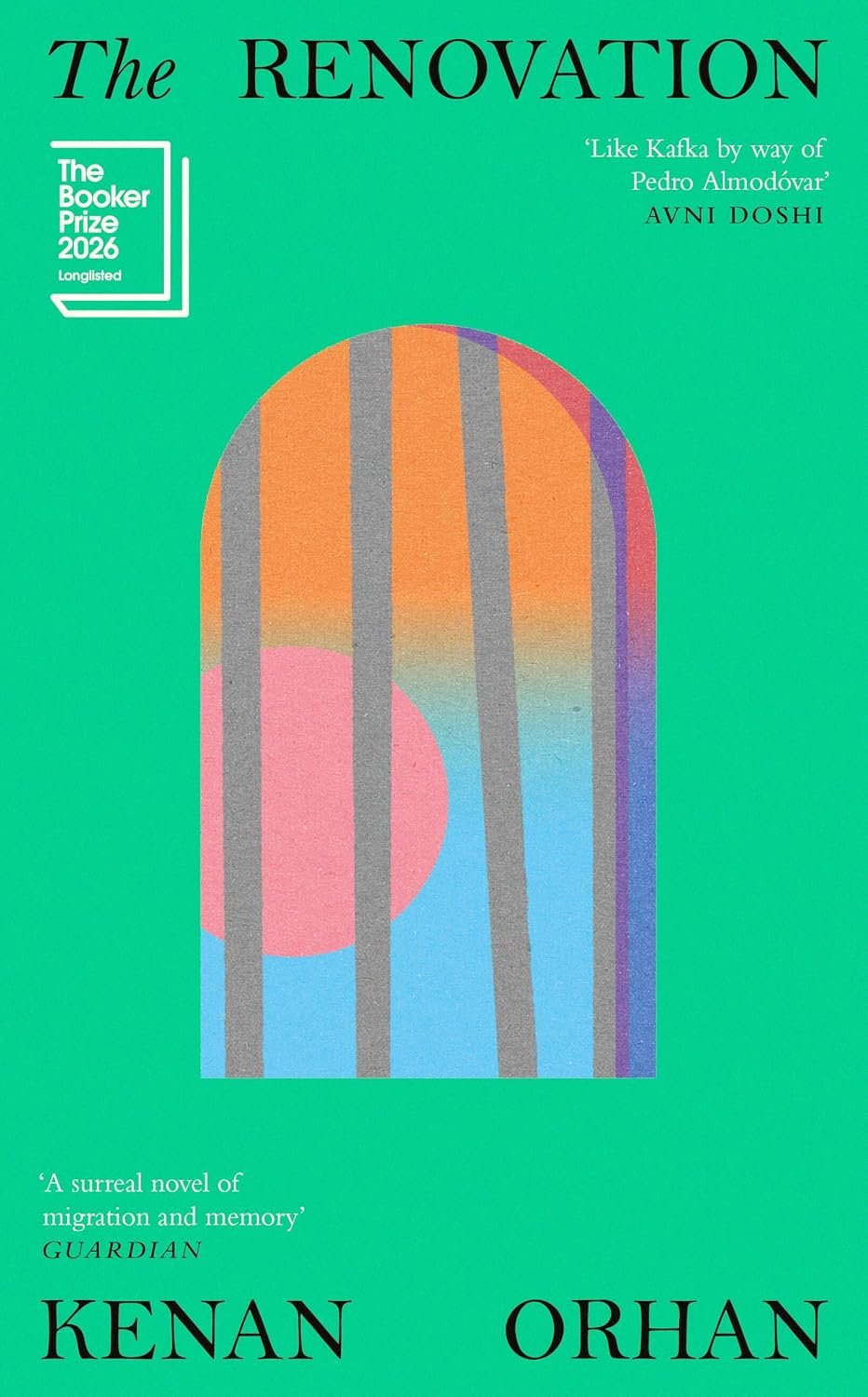

What happens when the home that an exile has built in a foreign land suddenly opens onto the prison of the country they left behind? Kenan Orhan’s debut novel The Renovation (2026), long listed for the Booker Prize, begins with precisely this impossible situation. Dilara, a Turkish woman living in Italy, has left Turkey with her husband and her dissident father amid the political repression that followed the Gezi Park protests, the failed 2016 coup attempt, and the subsequent consolidation of Erdoğan’s rule. She commissions the renovation of a bathroom in her Italian apartment, only to discover that the completed room is not a bathroom but a Turkish prison cell, specifically the Silivri Prison in Istanbul, a site linked to the imprisonment of political dissidents.
The absurdity of the premise is immediately serious. The bathroom, one of the most ordinary and private spaces in a home, becomes a passage into a political past. The geographical distance between Italy and Turkey collapses, and with it the assumption that exile can be understood simply as leaving one place for another.
Dilara has left Turkey, but Turkey has not disappeared from her life. It survives in language, food, smells, memories, family histories and, finally, in the architecture of her home. Orhan therefore turns exile into architecture. The prison cell is at once a reminder of what Dilara escaped and a return to what she has lost.
Initially, she experiences it as an intrusion. Yet the cell gradually becomes a place of familiarity. She can speak Turkish with the guards; she encounters other Turkish women; and the space evokes the sensory world of Istanbul. What should represent imprisonment consequently becomes a site of attachment. This paradox prevents the prison from functioning as a straightforward political allegory.
It is connected to Turkey’s recent history of political repression, but it is also the physical manifestation of a more intimate problem, i.e. what remains of home after one has been forced to leave it? The novel suggests that displacement does not end at the border. A homeland can become portable, carried through language and sensation, even when returning to it is impossible. The contradiction is central to the novel, the place that confines others offers Dilara a form of belonging.
Orhan’s own experience provides an important context for this intertwining of political displacement and personal memory. In interviews surrounding the novel, he has spoken about writing it amid his frustration with the political situation in Turkey, the experience of watching the country change, and his own distance from family and friends who remained there.
Orhan has also connected the novel’s treatment of memory to witnessing memory loss within his own family. These experiences do not simply provide the novel with autobiographical content; rather, they help explain why political displacement and familial forgetting become so closely intertwined in its imaginative structure. In The Renovation, the loss of a country and the loss of memory consequently emerge as distinct but resonant forms of rupture.
Dilara’s father introduces another dimension to this problem. If she has been displaced geographically, he is increasingly displaced from the present by Alzheimer’s. His illness gradually erodes his ability to remember words, recognise people and orient himself in the world. Dilara therefore finds herself in an unusual relationship with memory, she must preserve what he is losing. Her father’s forgetting produces a peculiar reversal of her own condition. She is compelled to remember what he can no longer remember.
This renders care giving more than a secondary plotline. It becomes one of the principal ways in which the novel understands displacement. Dilara’s father’s illness demands constant attention to his bodily vulnerability, while her own life contracts around the responsibilities of care. The home she has established in Italy, a place of refuge, becomes increasingly structured by exhaustion, obligation and isolation. The novel’s treatment of care is distinctly gendered. Dilara relentlessly carries the practical and emotional burden of her father’s dependence, while her marriage deteriorates under the pressure of their circumstances.
Orhan does not suggest that care giving is equivalent to political imprisonment. Rather, he places different forms of restriction alongside one another. The political prisoner is constrained by the state; the exile by separation from home; the person with dementia by the deterioration of memory; and the caregiver by the demands of another’s vulnerability. Their circumstances are not interchangeable, but their proximity reveals how political histories continue to shape private lives.
The women inside the prison extend this argument beyond Dilara’s family. They transform the cell from an individual psychological space into a collective one. These women are not simply extensions of Dilara’s memories; they belong to the political reality of imprisonment that the novel’s surreal premise initially obscures. Their presence gives the cell a social and historical dimension, while also foregrounding the gendered experience of political repression.
The novel is most compelling when it refuses to separate political history from ordinary experience. Orhan repeatedly moves between the social and the intimate, repression and marriage, exile and unemployment, political violence and the physical labour of lifting an elderly father from the floor. The resulting scale is one of the novel’s strengths. The political is never entirely abstract because it is registered through bodies, relationships and domestic routines.
This is also where Orhan’s prose becomes particularly important. The novel does not treat its surreal premise as an invitation to elaborate fantasy for its own sake. Instead, the strange and the ordinary coexist in an understated manner. The prison cell is absurd, but Dilara’s response to it is often practical, weary and even humorous. Reviewers have particularly noted the combination of surrealism, humour and lyrical prose in Orhan’s treatment of exile and caregiving.
The sensory dimension of the writing is especially effective. Turkey returns to Dilara not simply as an idea but through smells, tastes, sounds and fragments of language. Istanbul is reconstructed through remembered details rather than political exposition alone. This is important because exile in the novel is not merely intellectual nostalgia. It is embodied. The homeland persists because it has been absorbed into the habits and sensations through which a person experiences the world.
Language has a similar function. Dilara’s life in Italy requires her to inhabit another linguistic environment, while Turkish becomes increasingly associated with intimacy and recognition. The prison thus restores something that geographical relocation had interrupted. In an ironic reversal, the cell offers a linguistic freedom unavailable elsewhere. The space is restrictive in its institutional meaning but liberating in its capacity to return Dilara to a language in which parts of herself remain intact.
The novel’s central metaphor is not without its risks. Because the prison is made to carry so many meanings, political repression, exile, memory, care giving, cultural belonging, it occasionally approaches symbolic over determination. The danger is that every element of Dilara’s life begins to appear as another version of imprisonment.
The novel is strongest, however, when the cell remains ambiguous, neither simply Turkey nor merely a metaphor for psychological confinement, but a space in which these meanings intersect without becoming identical. This ambiguity also distinguishes The Renovation from a conventional political novel.
Orhan does not construct a linear narrative of repression and resistance. Instead, political history enters the domestic sphere through an impossible architectural opening. The bathroom becomes the point at which the private and political can no longer be kept apart. The absurdity of the premise therefore has a precise literary function: it makes visible the persistence of historical experience within apparently ordinary lives.
There is, finally, a deeper irony in the title. A renovation promises improvement, renewal and adaptation. Dilara wants to modify her home to accommodate the changing circumstances of her family. Instead, the renovation exposes everything that cannot simply be renovated away: the homeland, political history, familial responsibility, grief and memory. What appears to be a failure of construction becomes a revelation about the limits of constructing a new life.
The Renovation is consequently less interested in whether Dilara can escape Turkey than in whether escape can ever be complete. The prison follows her because the past is not located exclusively in the place one has left. It survives in language, in the body, in family relationships and in the memories that become especially fragile when someone else begins to lose them.
Orhan’s most striking achievement is to give this problem a physical form. The prison is not simply a symbol of Turkey. It is the form that Turkey takes after exile: distant, inaccessible, politically charged, yet unexpectedly intimate. At the same time, Dilara’s father’s illness gives the novel another kind of absence to inhabit. While she carries an excess of memory, he is gradually losing his relation to it. Between these two conditions, remembering what has been lost and witnessing someone else has forgotten, the novel locates the emotional complexity of exile.
The bathroom therefore remains more than an eccentric literary device. It is the room in which the novel’s contradictions meet, home and prison, refuge and responsibility, homeland and foreignness, remembering and forgetting. Orhan’s surrealism gives these contradictions architectural form without entirely resolving them. And perhaps that is the novel’s most persuasive insight, i.e. sometimes leaving a place does not mean leaving it behind. Sometimes the places we flee become the rooms in which we continue to live.