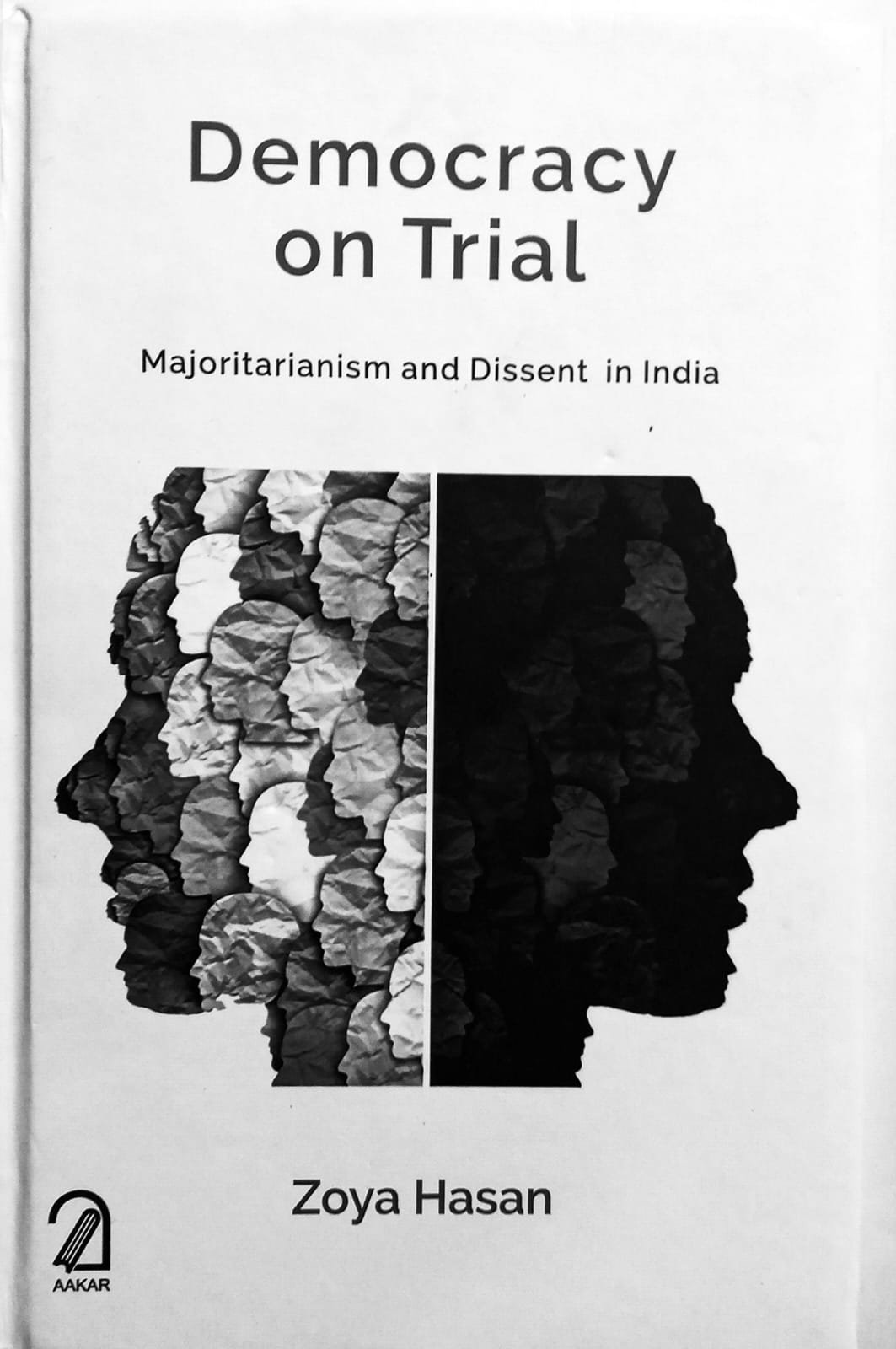

On 24th October 2026, Free Voice organised a book discussion. This has been Free Voice’s decision to organise discussions on books, scholarly articles, intellectuals and even artistic cinema every two-three months. The intention behind such discussions is to associate with fellow intellectuals. Despite having a small audience, Zeeshan Husain presented the book Democracy on Trial (2024) by Zoya Hasan thoroughly. Hasan is a renowned political scientist who has written on Congress party, state, India’s Muslims and Muslim women.
The book deals with the status of democracy in India between 2014 and 2024. Globally, there has been increase in wealth inequality and the consequent social conflict. The story of India is also on the similar lines. India started faltering from the 1990s onwards. In 1991, market was opened and Babri Masjid was demolished. It marked the slow but steady rise of the Hindu right.
1st chapter proposed majoritarianism as ‘majority with minority complex’. Three major events have happened. First was the abolition of Article 370, second was the Ayodhya judgement and third was the enactment of Citizenship Amendment Act. Alongside these, we also had growing strictness of anti-conversion laws, increasing hate speeches delivered by political leaders and mob lynching of Muslims. Towards the end, book states various forms of discrimination faced by India’s Muslims.
2nd chapter talks about shrinking space for dissent against the government. Hasan states cases being filed against NGOs, think tanks, and Civil Society organisation. Any educational institutes trying to engage in critique of the government’s policies were also targeted. Lastly, even Bollywood was targeted for making progressive films like Thappad.
3rd chapter discusses how media is controlled to peddle news and views of the government in power. Rather than questioning power and asking for more accountability and transparency, it questioned opposition! Media depends on funds and hence corporate and government control its narrative. Inefficiency of private sector remained unquestioned, critical websites got blocked and even honest journalists were harassed.
4th chapter examines slow and gradual decay in the language of rights into language of duties. Duties can only be performed when the government gives agency to citizens to exercise their choice. Government diluted Forest Rights Act, Right to Education, Food Security Act and NREGA. This shift in discourse changed the way in which government (not) responded to Covid epidemic and growing unemployment.
5th chapter addresses increasing public protests against government’s policies. Hasan has taken two such protests as case studies: anti-CAA protests and farmers’ protests. The former demanded citizenship without consideration of religious denomination while the latter demanded food security for all. Both had substantial allies across India and women participated in high numbers. Government accepted the demand of farmers’ protest but refused to accept anti-CAA demand.
6th chapter explores the importance of opposition in a democratic set up. Ruling party labelled Congress and other regional parties as illegitimate. It split them as far as it could and employed various agencies like ED and CBI against their leaders. This led to complete neglect of urgent issues like employment, development and healthcare.
At the end, Zoya Hasan in her last chapter shows how democracy in India has been in ruins since 2014. After the presentation, a young member of the audience asked how to select a book for reading and reviewing. In coming months, Free Voice is planning to organise more such scholarly discussions. If you are interested in presenting any book, journal article or even movie please drop us a short email at editor@freevoice.co.in. We will get back to you within a week.