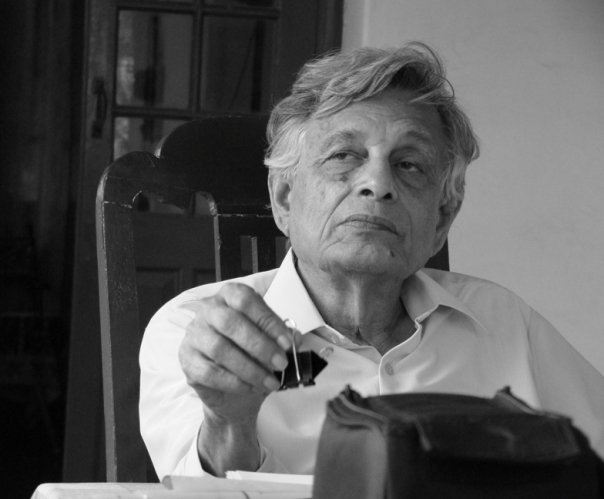

I first heard about historian Irfan Habib from a young man who was visiting my father at our hometown. He was a fresh student of history in Aligarh Muslim University (AMU). He told my father that there is a professor who has memorised the whole of medieval history! I was astonished to hear this. How can someone memorise the whole of history?
Years later when I got admission in AMU, I made it a point to just see who that professor was. That moment came after 3-4 years when I got to know that history department is having a guest lecture. I still remember it was Athar Ali Memorial Lecture and the topic was ‘Haj Pilgrimage by Sea during Early Modern Times’. I forgot the name of the speaker. I just went there to see who Irfan Habib was. I entered Arts Faculty Lounge with much fear. And there he was sitting— slim, old, average height and stoic looking. I was elated to see him. With time, I kept visiting the School of Social Sciences whenever there was any program just to see Irfan Habib. I have written ‘see’ because I could rarely understand what he said. Slowly, I started to understand the language of social sciences.
AMU days: One strange event happened in a year or so. A student who graduated from the university was leaving his hostel and clearing out his room. He asked me to take hostel magazine published by our hostel named Sir Ziauddin Hall. In it, there was an article by Irfan Habib titled Rewriting of History by the Sangh Parivar (2002). I had to read it multiple times to get some basic idea. Similarly, after a year or so I got a magazine published by AMU where it had a chapter on gender by Irfan Habib. I read it too; again multiple times. It took me a while to understand this essay as well.
MA days: It was in Master’s program that we were first asked to read a chapter of his book Indian Economy, 1858-1914. That chapter showed us how exploitative colonial economy was. I referred to it in my answers during exam. It was during the same time that I read his essay on the idea of India published in some magazine. That essay was relatively lucid and I could understand it quite well. Reading this essay gave me confidence that I can read and understand Irfan Habib, or at least his popular writings, if not academic ones.
PhD days: Days went by and I joined PhD where I got sometime on my own. I invested it in reading Habib sahab’s one and only textbook of history– Medieval India: The Study of a Civilization (NBT, 2007). It dealt with the period from 600 AD to 1750 AD. Each chapter had sections on society, polity, economy, technology and even arts and literature. I found it to be very lucidly written and always recommend it to my young friends.
History of the Idea of India: Now I would like to share my understanding of Irfan sahab’s work- Building the Idea of India. ‘Building the Idea of India’ is a lecture which Habib sahab delivered in AMU in 2015. Here he is talking about the rise and development of the idea of India and the challenges it is facing today. His speech is full of fascinating nuggets. For example, the term ‘Bharat’ occurs for the first time in an early inscription in Prakrit language. ‘Hindu’ is a Persian term, which is a distorted term for the Sindhu river (Indus).
Another interesting piece of information in the speech is the mentioning of first patriotic poem on India. The poem is Nuh Siphir (1318) by Amir Khusrau. When Akbar and Abul Fazl enacted Sulh-e-Kul (equal acceptance of all religions), they presumed India as a political entity. Habib mentions the book The Influence of Islam on Indian Culture (1928) by Tara Chand as a pioneering work in this regard. Similarly, we are told that even the Hindu sepoys of the Revolt of 1857 accepted Bahadur Shah Zafar as their king. However, it is the consciousness of colonial exploitation which consolidated India as a nation as we understand today.
Economic exploitation during colonial rule: Dadabhai Naoroji, Ramesh Chandra Dutt and Justice Ranade showed that the logic of free-trade was eyewash for the drain of wealth from India to Britain. However, this consciousness was limited to the intellectual elites who were English-educated. Common Indians were divided along the lines of caste, religion and gender. Reformists like Raja Rammohan Roy and Keshab Chandra Sen wrote against untouchability, patriarchy and caste hierarchy. Despite all these efforts, India still remained a nation in the eyes of handful of people.
Freedom Struggle: The idea of free India, as against British India, was popularised among the masses by Gandhi and Nehru. Just after arriving in India, Gandhi started Champaran Satyagraha in 1917 and then Non-Cooperation Movement in 1920. He understood the importance of peasants, workers, women and other marginalised groups in the making of a nation. Habib highlights that Gandhi accepted Indian Councils Act, 1909 which gave few concessions to Muslims. After Gandhi, was Nehru. He, from 1928, demanded not only Independence but also need to actualise the rights of peasants, workers and women alongside accepting mass suffrage. The Left was always standing in favour of such demands.
Habib highlights Karachi Resolution of 1931 as one of the best steps taken by Congress. Civil Disobedience Movement of 1930 was supported by a large section of people. He also quips about participation of Khudai Khidmatgars in the National Movement. Bhagat Singh and Subhas Chandra Bose were both aware about the dangers of Hindu communalism. Bose made Hindi and Urdu as the official languages of the Azad Hind Fauj. After Independence, Nehruvian India strove for land reforms and industrialisation. Towards the end, he asks young minds to strive for a secular and prosperous India. India that we aspire to build, Habib sa’ab asserted, must include all religions and eliminate poverty, unemployment, and hunger.
Legacy: Today we are seeing two types of attacks on social sciences. First, there is a gradual lessening of funding for research and teaching and second, the distortion of social sciences by the ruling elites. The field of history is extremely vulnerable to both the attacks. That is why we need to look at the work of Irfan Habib and take inspiration. The length and breadth of his oeuvre shows that he is a living legend. Hope he continues to work in favour of history and humanity at large.