
In tribal regions, farming has never been merely a means of livelihood it has been a way of life carried forward across generations. Yet as times have changed, some farmers have chosen to draw on their experience and fresh thinking to venture into experimentation. Mangalsingh Ganaga is one such farmer, who, alongside traditional cultivation, embraced organic turmeric farming not only raising his own income but also setting an inspiring example for the farmers around him.
Turmeric has long been an inseparable part of Indian kitchens and Ayurvedic medicine. For centuries it has been used in medicinal treatment. The compound curcumin found in it is what gives turmeric its yellow colour, and it is this same compound that endows it with rich medicinal properties. Turmeric has traditionally been used to treat ulcers, stomach ailments, and a range of other conditions. Beyond this, turmeric finds its way into the kitchen of nearly every Indian household every single day, which keeps market demand steady throughout the year. This is precisely why turmeric cultivation offers farmers a highly profitable crop at relatively low cost provided the farmer has access to the right technique and guidance. Mangalsingh Ganaga’s story is a realisation of exactly this potential.
Phalwa village, located in the Anandpuri tehsil of Banswara district, is a predominantly tribal area where the majority of the population still depends on farming and animal husbandry. Mangalsingh Ganaga, a resident of this village, has for years cultivated a variety of crops across both the kharif and rabi seasons on his six bighas of irrigated land. During the kharif season he mainly grows maize, black gram, sesame, and patharia rice, while chickpea and wheat have remained his principal rabi crops. Alongside farming, animal husbandry forms a vital part of his livelihood. He owns four buffaloes, two bullocks, three cows, and five goats, which not only provide milk and resources essential to farming but also serve as a reliable source of organic manure.
Mangalsingh Ganaga’s life as a farmer began with conventional methods, but within him there always lingered a desire to try something new and experiment on his own land. Speaking about this, he says he had long harboured the intention of undertaking experimental farming on his land alongside his traditional crops, but the lack of proper guidance had held him back. The turning point in his life came when he came into contact with Lalita Makwana, a facilitator with the VAAGDHARA. Lalita Makwana connected him with the Gram Swaraj Samuh, through which he learned about VAAGDHARA’s “Sachchi Kheti” (True Farming) programme. Under this programme, he was given a detailed understanding of what organic farming is, how it can be beneficial, and just how important and necessary organic farming has become in the present era. This guidance gave direction to the experimental instinct hidden within Mangalsingh and inspired him to adopt true, organic farming.
Embracing the principles of Sachchi Kheti, he began reducing his dependence on chemical fertilisers and pesticides, turning instead to organic measures such as cow-dung manure and dashparni extract on his land. To secure a good turmeric yield, he applies cow-dung manure regularly to his field and sprays dashparni extract as needed. A distinctive feature of his farming is that he has continued growing maize alongside turmeric on the same land. This strategy of mixed cropping has given him an additional source of income beyond the profits from turmeric. With the aim of earning greater profit, rather than simply selling raw turmeric, he began grinding it into powder and packaging it for sale in the market. This processing has helped him command better prices for his turmeric in the market.
Under VAAGDHARA’s Sachchi Kheti programme, Mangalsingh Ganaga was provided five kilograms of turmeric seed to begin cultivation on his land. He planted this seed on a square plot measuring twenty by twenty-five feet and applied four hundred kilograms of cow-dung manure sourced from his own livestock. The technical guidance he needed for this came through the Farmer Field School run by VAAGDHARA, where trainers explained the entire process in detail, from sowing to harvesting. He sowed the turmeric in the first week of July 2025 and harvested it in May of the following year. From five kilograms of turmeric seed, he obtained a total yield of sixty kilograms of turmeric. Of this sixty kilograms, he sold twenty kilograms of raw turmeric at a rate of one hundred fifty rupees per kilogram, earning him up to three thousand rupees. The remaining thirty kilograms he processed into powder and sold at four hundred rupees per kilogram, bringing in an additional twelve thousand rupees. The remaining ten kilograms of turmeric he kept aside for household use and as seed for the next crop.
Mangalsingh did not even need to travel anywhere to sell his turmeric. Those who bought it spread the word themselves, since the turmeric was free of chemicals. In all, Mangalsingh Ganaga earned a total income of fifteen thousand rupees from turmeric cultivation.
In Mangalsingh’s journey, the role played by his wife, Shantidevi Ganaga, has been equally significant. VAAGDHARA not only helped raise the family’s income but also undertook meaningful efforts to improve the family’s health and nutrition. As part of this, Shantidevi was provided a vegetable kit under the nutrition garden (Poshan Vatika) initiative, which included a variety of vegetables such as okra, cowpea, bottle gourd, ridge gourd, tomato, brinjal, cluster beans, fenugreek, spinach, and chilli.
Sharing her experience, Shantidevi says that VAAGDHARA supported not just her livelihood but also her family’s health, by providing her a vegetable kit through the nutrition garden. Growing these vegetables not only met her family’s nutritional needs but also brought them economic benefit. By selling vegetables through the year, Shantidevi earned sixty thousand rupees, a substantial contribution to the family’s overall income. Expressing her gratitude, she adds that she is thankful to VAAGDHARA for inspiring her towards organic farming and helping increase her livelihood.
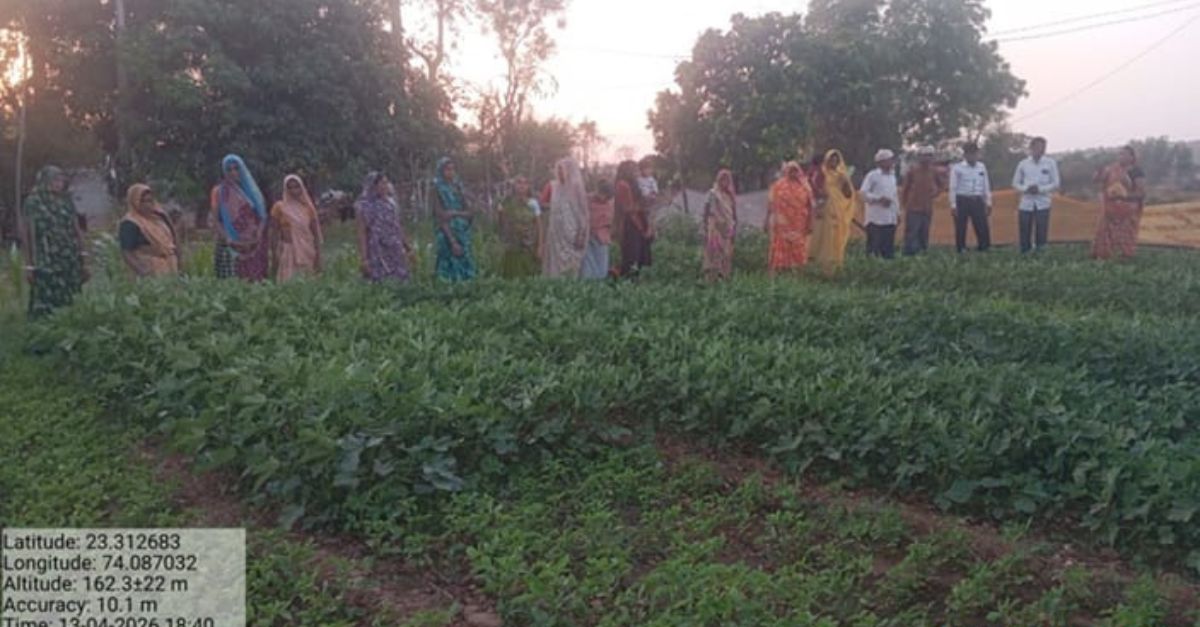
Both Mangalsingh and Shantidevi Ganaga have been regular participants in the Farmer Field School, where VAAGDHARA’s community facilitators teach them the finer points of organic farming. Training programmes of this kind not only impart technical knowledge but also serve as a powerful platform for farmers to exchange experiences. Throughout this process, the role of community facilitators has been noteworthy they have provided technical guidance while also working to build confidence among farmers. Initiatives such as the Farmer Field School and the nutrition garden are bringing about real change at the grassroots level. These programmes are not only improving the economic condition of farmers but are also steering them towards organic and sustainable farming, which will prove beneficial for soil health and the environment in the long run.
Their work offers an important lesson: diversification in farming incorporating different crops and activities within the same piece of land greatly strengthens a farming family’s economic security. Mangalsingh’s grain crops, his turmeric cash crop, and the income Shantidevi earns from vegetables grown in the nutrition garden together protect the family from the risks posed by the failure of any single crop or season. This is regarded as one of the most suitable approaches for agricultural development.
Through the dedication of hardworking farmers like Mangalsingh and Shantidevi, this journey of organic farming will surely show many more farmers the path to self-reliance in the times ahead. They will not only be able to strengthen their own economic position but will also be able to make a meaningful contribution to environmental conservation and the production of healthy food.