
Introduction
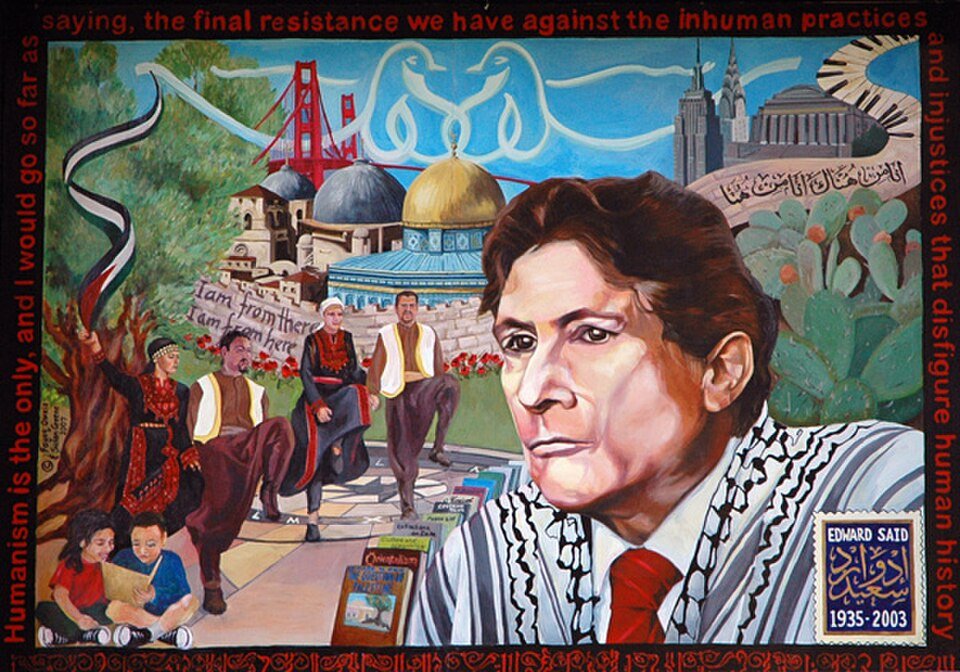
Edward Said spent his whole life speaking for people who had no voice. He was born in Jerusalem in 1935. His family became refugees in 1948. He taught at Columbia University for forty years. He became one of the world’s most influential literary critics. He wrote over twenty books. They were translated into more than thirty languages. He believed knowledge should help us understand the poor, the weak, and the forgotten. He asked difficult questions. He stood up for those who were forgotten. Today, we remember him through his three earliest and most famous books.
Orientalism
Edward Said’s Orientalism (1978) argues that Western knowledge about the East is not based on facts but on preconceived stereotypes and cultural superiority, creating a false otherness that justified imperialism. Said traces how Europe defined the Orient as mysterious, unchanging and inferior, preventing the East from representing itself. This power-knowledge discourse served colonial domination. Said shows early Orientalism produced knowledge without fieldwork, while later phases served colonialism directly. The Orient was asserted against the West, hence this distorted view. For Said, there is no true Occidentalism, since the Orient lacked the power to produce such a discipline.
The Question of Palestine
Edward Said’s The Question of Palestine (1979) explains the conflict by placing the Palestinian experience at the center. He argues that the creation of Israel was shaped by European colonialism and anti-Semitism. Said was himself a Palestinian exile. He showed how Arabs, the original residents of the land, were erased from the story. Said yearned for his home, Palestine, all his life. Said, alongside Ilan Pappé, Rashid Khalidi, and Noam Chomsky, remains one of the four best minds on this question. The book is a cry against injustice. He envisions a shared future based on equality and mutual recognition, not domination.
Covering Islam
Edward Said’s Covering Islam (1981) shows how Western media shape what we think about Islam. The news often paints all Muslims as one group. It links Islam with terrorism and violence. Said says experts and journalists repeat these simple, negative images. He wrote the book after the 1979 Iranian Revolution, when Western media coverage of Islam became highly distorted. The media turned Muslims into caricatures. He wanted people to see that this “covering” hides the real, diverse lives of Muslims. The book asks us to question what we see on TV and read in papers.
Conclusion
Said is an inspiration for all those who produce knowledge for the betterment of society. His work is still relevant. Most people still do not understand Muslims, Islam, or Palestine. They also do not understand the power-knowledge web. Even today, people take inspiration from his works. Historian Mushirul Hasan took inspiration from his work. Said’s critical consciousness means the ability to challenge hegemony. It means asking what is invisible in texts. This remains essential for any justice-seeking intellectual today. His call to speak truth to power still echoes for all who refuse to be silent. We must keep his memory alive as an inspiration.