
Introduction
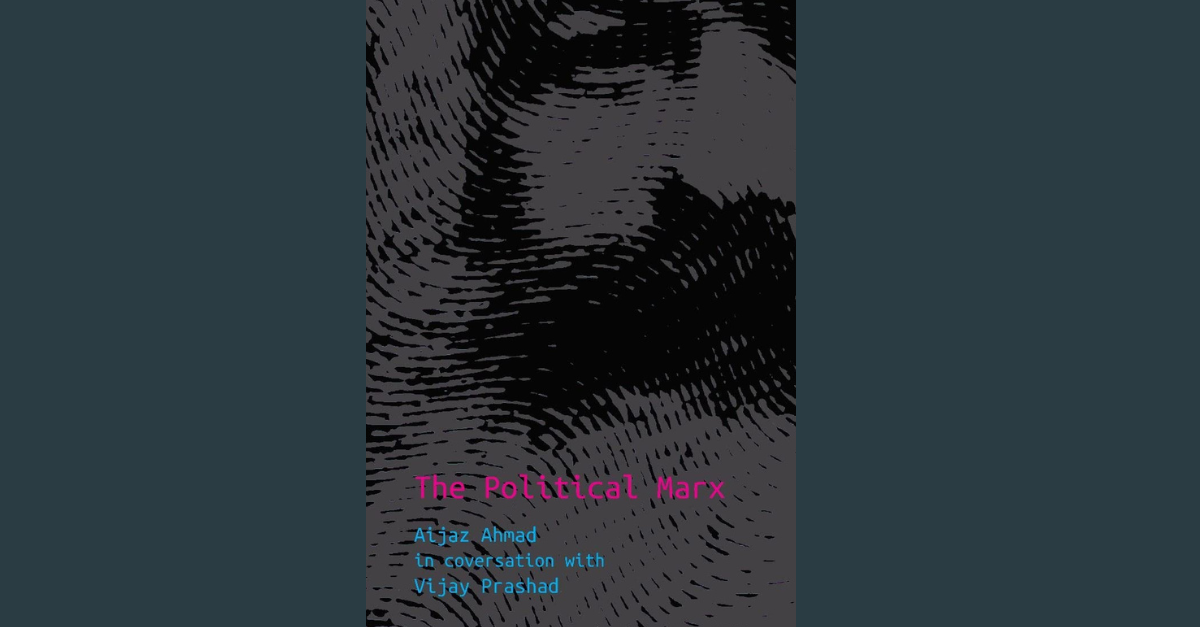
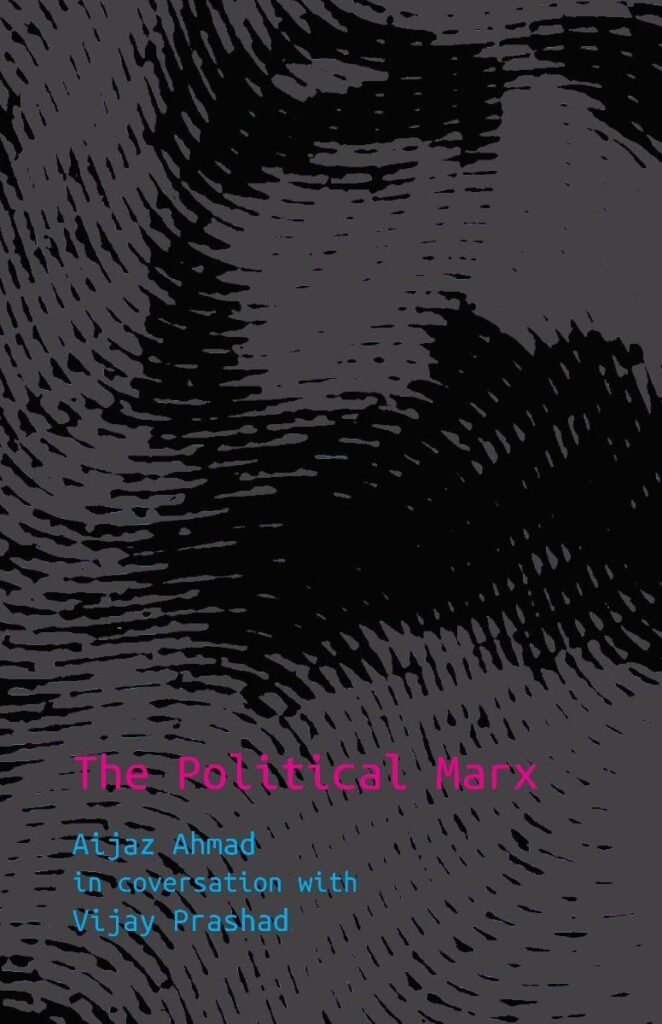
Whenever we utter the name of Karl Marx (1818-1883), the first thing that comes to our mind is Das Kapital (1867)—the subtle analysis of economics, the theory of surplus value, or the contradictions inherent in the Industrial Revolution and modern capitalist society. But Marx was not merely an economist; he was a political thinker, a revolutionary strategist, and a theorist of the state. To understand Marx without his political writings is to not understand him fully. It is precisely this truth that the eminent Marxist thinker Aijaz Ahmad brings to the forefront in his final work, The Political Marx: Aijaz Ahmad in conversation with Vijay Prashad, a 110-page book published by LeftWord in 2023.
Friedrich Engels (1820-1895), in his speech delivered on 17 March 1883 at Marx’s graveside in Highgate cemetery, London, said that Marx was, above all, a revolutionary. The true mission of his life was to participate, in one way or another, in the overthrow of capitalist society and the state institutions it had created, and to contribute to the emancipation of the modern proletariat. He was the first to make the proletariat conscious of its own condition, its needs, and the conditions of its liberation. His very nature was one of struggle. The passion, perseverance, and success with which he fought are unparalleled (Lenin, Marxism, Radical, 2022, p. 55).
The book under discussion is based on a series of conversations between Aijaz Ahmad and Vijay Prashad, the head of LeftWord Books. Ahmad was indeed a true Marxist theoretician, but he was also a literary theorist, a sharp critic of colonial thought, a historian, and an explorer of identity.
A major regret in Aijaz’s life was that Marx is often reduced solely to his economic work, ‘Marx is thought of too narrowly for his economic work’ (p. 11), thereby, diminishing his stature. Yet Marx’s political writings—The German Ideology (1845), The Communist Manifesto (1848), The Eighteenth Brumaire of Louis Bonaparte (1852), and The Civil War in France (1871)—are the key to understanding his revolutionary vision (p. 11).
Ahmad’s reading is not merely a historical review; rather, it is a practical curriculum for contemporary political struggles. Political Marx reminds us how relevant Marx’s politics still is today, especially at a time when imperialism and authoritarianism is ever expanding globally in new forms.
Now, we will try to closely examine Marx’s political writings one by one. These works testify to the depth, breadth, and contemporary relevance of Marx’s political thought. Hence, they are timeless.
The German Ideology
This chapter primarily discusses a new method of understanding history proposed by Marx and Engels. Here they present not philosophy or idealism, but the material conditions of life as the driving force of history. This idea later came to be known as historical materialism. In other words, human consciousness does not create society; rather, society, the mode of production, and relations of production shape human consciousness. ‘The history of human beings is a history of production; production itself is at its heart the act of human beings on external nature. The relationship between internal nature and external nature is condensed in the act of production.’ In capitalist mode of production this relation is ‘torn asunder,’ leading to alienation of human beings (pp. 25-26).
Aijaz Ahmad explains that this book is not just theoretical—it is a political weapon that warns idealist revolutionaries that the real revolution lies not merely in changing ideas, but in transforming relations of production. Marx showed that the course of history depends on the process of production and relations of production, neither of which is subject to individual will.
Friedrich Hegel (1770–1831) argued that social conflict originates in the clash of ideas and ideologies. Marx demonstrated that human consciousness and philosophical conflicts are actually abstract expressions of real social conflicts rooted in specific historical conditions. Material contradictions, particularly, between the forces of production (both the means of production, including machinery, and labour power) and the social relations of production (or the forms of economic ownership of the productive forces, with special emphasis on private property) give rise to philosophical contradictions.
What Hegel called “Spirit,” Marx rejected. According to Hegel, social being determines class divisions, whereas Marx showed that class divisions determine social being. One is not an owner because one possesses labor power; rather, one is an owner because one has already appropriated it. This is why, Marx’s philosophy is not mere materialism but historical materialism. That is why, Marx talks about putting Hegelian dialectics on its head; the inversion from idealism to historical materialism, not materialism (p. 19).
Ludwig Feuerbach’s (1804–1872) materialism was ‘ahistorical,’ where nature was seen as fixed and unchanging. As a result, he and his followers viewed social relations as permanent. Feuerbach considered existing nature as ‘final’. Marx, however, showed that what we perceive as ‘eternal nature’ is actually a historically evolving form. It has changed before and will change again. Just as nature is not eternal, social relations are not permanent either. This is where Marx’s historical materialism differs from Feuerbach’s materialism.
On the limitations of Hegel and Feuerbach, Marx wrote that philosophers have so far taken refuge under one set of interpretations to combat another, turning the struggle into one of changing interpretations rather than changing the world. Simply put, Young Hegelians and Feuerbach are fighting ‘abstractions with abstractions,’ or ‘phrases with phrases’. Thus, philosophical knowledge has remained a mere approximation of truth. According to Ahmad, Marx liberated philosophy from speculative imagination and grounded it in historical consciousness (p. 23). The world cannot be changed merely through philosophical interpretation. This does not mean interpretation is unnecessary; rather, true understanding comes only through the effort to change the world.
It is in The German Ideology, not in the Manifesto, that Marx’s initial originality appears most clearly, where he transcends Hegel and Feuerbach to uncover the hidden dynamics of history through historical materialism. The German Ideology is a ‘fairly central text before the Communist Manifesto. The tentative narrative of the modes of production gets summarised and clarified, and you find an even more synoptic version in the Manifesto’ (p. 20). Social conflict is essentially conflict over ownership of resources. This insight is central to Marx’s originality and is later minutely elaborated in the Manifesto and Capital.
The Communist Manifesto
This chapter can be seen not merely as a political declaration, but as the first scientific outline of class struggle. Aijaz Ahmad emphasizes that Manifesto, largely written by Marx but published as a co-written text with his friend and collaborator Friedrich Engels, is not just an anti-bourgeois text; it is the first strategic document of international working-class unity.
It declares that history is the history of class struggle, and capitalism is not its final stage—it must be transcended. According to Ahmad, the strength of the Manifesto lies in its organizational language—it instills a sense of revolutionary responsibility in readers. Thus, it is not merely theory, but a handbook for propaganda and organization.
Marx spent his entire life exploring the logic behind the formation of capitalist structures. The initial phase of this work is recorded in the Manifesto. Everything he later wrote expands upon the ideas presented here. It is a text of its own time in its political logic. Marx will be engaged for the rest of his life trying to elaborate and work out the logic that is stated here in such a condensed way (p. 36).
Marx viewed the proletariat as a philosophical category—the class that would lead world revolution. He wrote that this class would abolish private property and demonstrate that life is possible without it. The proletariat appears as a philosophical idea for Marx, as the universal class, the bearer of revolutionary potential, the one who can call for the ‘negation of private property’ because ‘it is only elevating to a principle for society what society has already made a principle for the proletariat’ (p. 38).
Why did Marx identify the proletariat as the revolutionary class? Capitalism itself creates and organizes a vast class of exploited people. This is the central tendency of social transformation. As capitalism expands globally, so too does the unity of the proletariat. As industrial production itself grows, the proletariat is going to grow with it. And as the capitalist mode of production exceeds national boundaries, the internalisation of the proletariat will also take place accordingly (p. 39).
What Marx emphasized is the unity of the proletariat. Despite divisions, a disciplined party is necessary to embody this unity. ‘The Communists do not form a separate party opposed to the other working-class parties’. If you read the Manifesto closely what is being said is that the proletariat is divided into so many different tendencies and so many different groups that making the Communist League the party of the proletariat would be purely an idealist assertion. What you actually want to do is to create a party of the whole, as Marx put it. And it is only when you have reached the point when you can claim that it is the party of the whole, that you can think of communists creating a party of their own, which in Europe they did not reach that point till 1880s’ (p. 40).
One of the enduring features of communist politics and Marxist thinking, which was unknown to Marx at that time, is ‘how to turn the national revolution into a class revolution (p. 41). How does the proletariat intervene in what is actually taking shape, both as a democratic upsurge against the monarchies as well as a great fear that these movements will become a national chauvinist movement, country by country….it is very much like Lenin’s theses on national liberation and the formation of the communist parties. Nationalism is real, national question is real. If you don’t take hold of it, if you don’t intervene in that process, you will be sidelined by history. Your real choice is to compete with the bourgeoisie, to defeat the bourgeoisie, to take hold of the revolutionary movement as it is developing (p. 42).
The Eighteenth Brumaire of Louis Bonaparte
What is the Eighteenth Brumaire? It refers to a date in the French Revolutionary calendar—9 November 1799—when Napoleon Bonaparte seized power through a coup. In 1848, this monarchy was overthrown, but Louis Bonaparte later repeated history by seizing power in 1851 and declaring himself Napoleon III. Marx described this as history repeating itself—first as tragedy, then as farce.
Marx argued that this was not merely a counter-revolution; it reflected the role of the masses, many of whom supported the coup during a time of crisis (p. 74). Louis Bonaparte became the emperor and restored the imperial institutions. And interestingly half of France believed that this was the proper role of the state. Bonaparte creates the conditions for the French bourgeoisie to grow not only within national space but to move ahead for colonial conquests in Algeria, in the Americas, in Africa and in Asia (pp. 74-75).
Some often cited lines from this text (p. 49) include:
1. History repeats itself—first as tragedy, then as farce.
2. People make history, but not under conditions of their own choosing.
3. The tradition of all dead generations weighs like a nightmare on the brains of the living.
These lines still leave a deep impression on people’s minds even today. To tell the truth, the basic foundation of Vladimir Lenin’s later writings on the state was precisely The Eighteenth Brumaire of Louis Bonaparte and Paris Commune. Marx had written that all previous revolutionary activities had either tried to repair the state or sought to correct it. Instead of such repair, what was urgently necessary was to smash the state structure, to shatter it completely (p. 50). It was that very idea which Lenin expanded further in his timeless book State and Revolution (1918).
Along with constructing a perspective regarding the state, Brumaire is especially noteworthy for another reason as well—that is Marx’s literary talent. That is why, even after so many years, this writing of Marx is still being used in explaining contemporary political situations. It did not become popular among readers in that way, because of its specific style of writing. Marx had actually observed with a sharp eye the dramatic political turns and twists that continued uninterruptedly for three years. And he also analysed those events in the light of the sharpness of scientific reasoning. To put in brief, in the Brumaire Marx made the method of understanding history more realistic. Here Marx demonstrated how the political reality of the existing social condition should be analysed.
This book is actually a moving history which ultimately reaches the establishment of counter-revolutionary politics. Here he shows that not only class struggle, but political strategy, alliances, centrist forces, the army and bureaucracy—all together constitute state power. Ahmad explains in this chapter that Marx here reminds us that the complexity of existing class relations is not linear. Along with various turns and twists, just as it constantly brings forth new possibilities in favour of revolution, similarly it also pulls forward every tendency of counter-revolution hidden beneath the current…. The hand of history keeps trembling between revolution and counter-revolution and finally tilts in such a direction that a great possibility of social transformation meets an untimely death. Revolution and counter-revolution actually return hand in hand. In revolutionary work there is no such thing as eternal defeat; with the passage of time, advances and retreats continue endlessly, ‘by fractions of classes in a relentless class struggle’ (p. 69).
One of the most important lessons that Marx left for us in Brumaire is that in the real world there is no opportunity to make two plus two equal four in the manner of theory. The truth of the world has to be understood by weighing it through a dialectical perspective—Marx accomplished that task through his extraordinary skill acquired through immense hardship and immense dedication.
The Civil War in France
In 1870 the war between Germany and France began. From then until the destruction of the Paris Commune, Karl Marx remained deeply attentive to all the events. During this time he delivered three speeches in the general sessions of the International Workingmen’s Association concerning the Paris Commune. The subject of the first speech (1870, 2 July) was the course of the war. The subject of the second discussion (1870, 9 September) was the events following the defeat of Louis Bonaparte at the hands of the Prussian army. And the third speech (1871, 30 May) was delivered exactly two days after the destruction of the Paris Commune (p. 85).
These speeches of Marx were later published in book form by Friedrich Engels during the celebration of the twentieth anniversary of the Paris Commune (1891). And he himself wrote the preface to the book. The name of that book is The Civil War in France. Alongside reviewing the history of class struggle in France, Marx here showed, through the skill acquired by immense labour, how daily political situations should be judged and analysed in the light of class struggle (p. 85).
Ahmad strongly says that while discussing The Civil War in France, it must be discussed in the light of The Eighteenth Brumaire of Louis Bonaparte. There exists an interesting continuity among The Communist Manifesto, The Eighteenth Brumaire of Louis Bonaparte, and The Civil War in France. The Manifesto had been written strengthened by the belief that revolution is inevitable. At the very time of its publication, revolutionary struggle began in France. Then Marx devoted himself to several writings regarding revolutionary war and the subsequent events. In those writings lay the embryo of The Civil War in France. How the fruits of that revolutionary struggle went into the hands of counter-revolutionary forces, and how Louis Bonaparte seized power through a military coup—Marx presented those explanations in Brumaire. Ahmad has presented these complex historical events in a simple manner for the convenience of general readers.
Therefore, The Communist Manifesto is the confident messenger of revolution; later, when that situation gradually culminated in counter-revolution, it was written about in Brumaire. Finally, when revolutionary forces were taking control of state power, its form became something entirely new—that was the Paris Commune, which appears in The Civil War in France. In the 72 days(from 18 March to 28 May 1871), during which it survived, whatever the Paris Commune established had no contribution from anyone except the proletarian class. For the first time in history, the proletarian class consciously entered into proletarian revolutionary struggle (p. 86).
In Marx’s thought, the dictatorship of the proletariat and the abolition of the state were synonymous. How the struggle to construct the dictatorship of the proletariat would bring about the abolition of the state apparatus—that was the central question. Merely taking control of the state machinery, or simply repairing it, would not complete the task—Marx himself had mentioned this in the final part of Brumaire; in the Paris Commune that thought took concrete form—that is the core of The Civil War in France.
Here Marx shows, from the experience of the Paris Commune, that the exploiting state must not merely be broken. Rather, it has to be replaced with a new kind of workers’ state. Ahmad explains that in this book Marx says clearly for the first time that it is not enough for revolutionaries merely to capture the old state machinery—it must be destroyed and a new system of governance created. Elected representatives, the right of recall, and abolition of the standing army—all these are proposed here. According to Ahmad, this is the most mature form of the Marxist political stand. The immense significance of this book is essentially captured in two phrases—‘dictatorship of the proletariat’ and ‘abolition of the state’ (p. 93). Lenin said that there is no reason not to share state power with all the people of the country. This sharing of power itself is the dictatorship of the proletariat. ‘This is what [power] needs to be dispersed among the classes, and therefore the building of this new state, which is the state of the dictatorship of the proletariat’ (p. 95).
Under bourgeoisie rule, state power means a vast organised political arrangement including the army, police, courts and judiciary, which remains active as a structure separate from the common people. The same applies in the case of parliamentary systems in conducting state administration. The goal and duty of proletarian revolution is to distribute that state power equally among the people. Therefore, the old state cannot in any way be used. It has to be smashed and a new state system built. The name of that system is the dictatorship of the proletariat (p. 95).
Lenin wrote that the lessons of the Paris Commune are not something only the working people of Paris or France should remember; they are part of the self-education curriculum of the working class of the whole world. They are a weapon in the work of preparing themselves to defeat the obstacles arising on the path toward the establishment of socialism and to emerge victorious in struggle (p. 101).
It was the lessons of the Commune that gave Lenin the courage to say that the proletarian class had until then worked sometimes in exchange for wages thrown by the capitalist, sometimes bowing before nobles, aristocrats and bureaucrats, or out of fear of punishment, but from now on they will work for their own interests (p. 97).
Lenin reminds us that therefore, in order to administer the state, all bourgeois-intellectual notions must be cast aside, those notions which teach that it is impossible to run the country without depending on the power of capital and officials possessing special social status. In the work of running the country, the proletarians must as quickly as possible free themselves from their defects through repeated practice. They must make themselves fit for self-government. And although this task cannot be accomplished overnight, it is not impossible to achieve through repeated practice (pp. 96–100).
Aijaz Ahmad commented:
Some people wish to present the October Revolution as the result of an unprecedentedly lofty revolutionary endeavour under the leadership of Lenin and the Bolsheviks; I disagree with such a conclusion. Before the October Revolution, the Paris Commune had carried out a similar revolution. Among the principal inspirers of the Paris Revolution were Marx and Louis-Auguste Blanqui (1805-1881). But the real work was done by the workers themselves; for that purpose they had carried on proper practice for three years. After this came the dawn of 18 March, when the whole of Paris awoke to the cry of Vive la Commune (pp. 98-100)!
Lenin himself, however, while celebrating the fortieth anniversary of the Paris Commune in 1911, wrote: ‘The cause of the Commune is the cause of the social revolution, the cause of the complete political and economic emancipation of the workers. It is the cause of the proletariat of the whole world. And in this sense, it is immortal’ (p. 101). This work is based on Marx’s analysis of the Paris Commune (1871). It shows how the working class can seize power and build a new kind of state.
Ahmad highlights the continuity between the Manifesto, Brumaire, and The Civil War in France. The Manifesto announces revolution, Brumaire analyses its failure, and The Civil War in France shows its realization in the Paris Commune.
Contemporary relevance
The greatest strength of The Political Marx is that here Aijaz Ahmad has brought Karl Marx back to the centre of contemporary political struggles. In the twenty-first century, capitalism is not merely an economic structure; rather, it is an all-devouring global project whose influence has spread across every layer of politics, culture, technology and morality. Today capitalism has turned into such an all-pervasive force that it is transforming even human thought into a market. In this context, Ahmad does not see the rereading of Marx merely as a theoretical exercise. Rather, he has reconstructed it as a kind of language of political resistance.
In the context of South Asia, this reading becomes even more imperative. The nexus of right-wing politics and corporate capital in India, market-dependent development under the shadow of authoritarian rule in Bangladesh, and the continued dominance of military and religious forces in Pakistan—through all these Ahmad wants to show that in this subcontinent the relationship between capitalism and right-wing politics is not merely economic, but deeply ideological. According to him, to understand this reality, a rereading of Marx’s political writings is indispensable.
Ahmad reminds us that if Marx is reduced merely to a theorist of economics, then the edge of revolutionary politics becomes blunted. His political writings are still sharp weapons of class struggle today. They are stepping stones toward the liberation of countless working people across the globe.
Conclusion
Political Marx is at once educational and inspiring. For those who wish to understand Marx’s politics anew, or who want to think about revolutionary politics in today’s world—this slim book can be an important text. It is also helpful for those who do not want to confine Marx merely within economics but wish to understand the political edge of Marxism in the context of today’s volatile world.
Aijaz Ahmad spent his entire life explaining the literary and political aspects of Marxism. This book is a brief compilation of that very effort. Its strength lies in explaining complex Marxist theories in simple language and placing them within immediate political relevance.
In today’s world, when capitalism, flawless global technological surveillance, years of war and continuous genocide, violent finance capital, and the use of the state machinery are exploiting the working class, peasants, and labouring people in ever newer ways—at such a difficult time it is imperative to reread Marx’s political writings anew. This book awakens precisely that urge. As capitalism is becoming even more violent on a global scale, I feel that Marx’s political writings have once again become essential reading.
However, within such a small scope, this book’s close discussion of so many important political works of Marx may seem quite difficult to first-time readers of Marxism. And that is not at all unusual. However, taking The Political Marx as a starting point, readers may become newly interested in making a deeper evaluation of the historical context of the reviewed texts and of their significance and relevance in the contemporary age of extreme capitalist and unpardonable imperialist aggression. It would not be baseless to hope so either.
The Political Marx: Aijaz Ahmad in Conversation with Vijay Prashad
LeftWord Books, 2023, pp. 110, Rs. 175/-