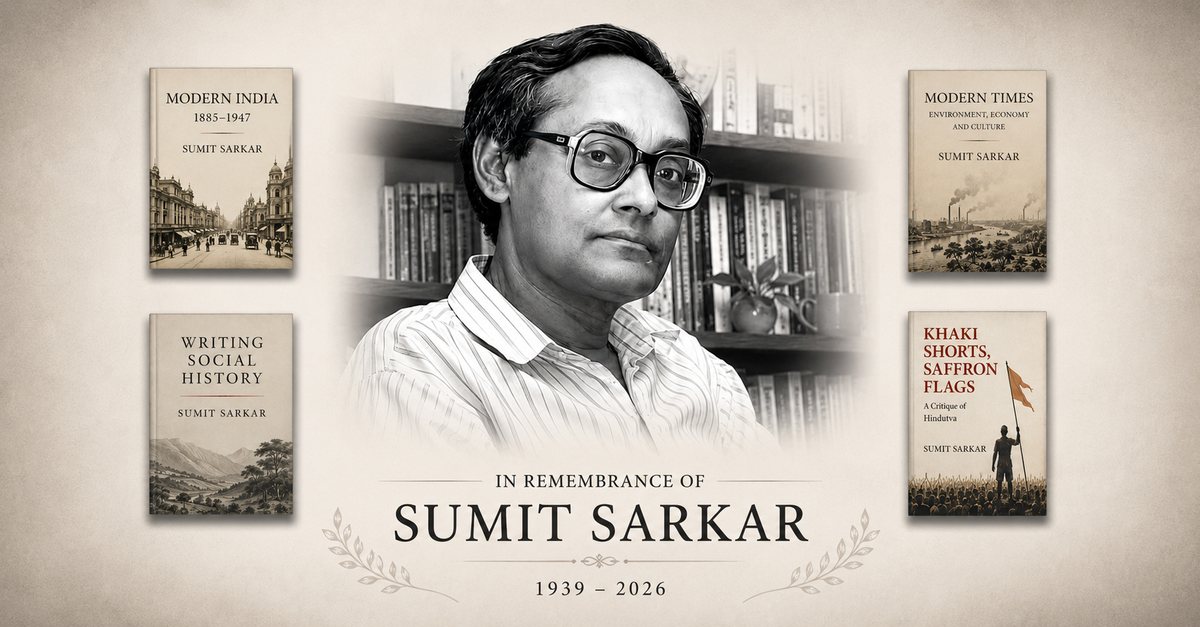

The passing away of Sumit Sarkar (1939–2026) marks the closing of a defining chapter in South Asian historiography. Reflecting on his life’s work is not merely an academic exercise, but an engagement with the very soul of modern Indian historical practice. At the core of his lifelong endeavour was a fundamental, deceptively simple question: why do we study ‘people’ in history? For Sarkar, history was never an abstract arena of distant, impersonal forces; it was a human drama where the “small (hu)man” mattered deeply—not as a passive bystander, but because his actions, resistances, and choices actively shaped and transformed his times. His intellectual legacy offers a blueprint for how a historian can maintain ideological rigour without surrendering to dogma—tracing his interrogation of nationalist mythologies, his materialist re-reading of social reforms, and his nuanced, often ambivalent evaluation of the Gandhian phenomenon.
To fully understand Sarkar’s monumental contribution, one must begin with the pedagogical and historiographical debates surrounding his most famous work (1983), Modern India 1885–1947. Condensing what was originally planned as a two- or three-volume treatise into a single volume under stringent publishing constraints, the work was published as an undergraduate textbook. Yet, as Arvind N. Das pointed out in his exhaustive 1984 review-essay in the Social Scientist, “History in the Present Tense: On Sumit Sarkar’s Modern India“, labelling it a “textbook” raises immediate generic and pedagogical questions. Can a work of such analytical density and archival depth function merely as a teaching aid, particularly at the postgraduate level, where students are expected to dismantle syntheses rather than absorb them? Das argued that the generic question must precede the specific: before evaluating Sarkar’s specific empirical findings, one must ask whether the textbook format inherently limits the expression of subaltern agency by forcing complex, localized class struggles into a singular, national timeline.
Das also criticized Sarkar’s textbook for having ignored the context of the legislation of the Bengal Tenancy Act 1885 and its fallout. Similarly, Carey Watt (1997) critiques Sumit Sarkar’s Modern India for treating 1909–1916 as a political “trough” between agitational waves. This was a vital “constructive nationalism” phase of institutional building, physical culture, educational reform, and organized civic service (seva) that forged the social base and cadres for Gandhi’s later mass movements.
Despite these structural limitations, Arvind N. Das (1984) and Vinay Lal (2001) both recognized that Modern India achieved something rare. Sarkar refused to treat Indian nationalism as a monolithic movement driven solely by elite negotiations or simple anti-colonial fervour. Instead, he meticulously detailed the vast regional and sub-regional variations across the subcontinent, showing how local agrarian realities, caste structures, and working-class initiatives routinely broke through, resisted, or reshaped the agendas of national leaders. The bibliographic essay at the end of the textbook remains a legendary repository of historical literature, and the inner chapters are packed with suggestions for unexplored research avenues that have sustained generations of doctoral researchers.
The 19th-Century Reforms and the Myth of the “Bengal Renaissance”
Sumit Sarkar’s textbook clarifies, why does he treat the beginning of modern period in Indian history from 1885 (rather than from, 1707, or 1757, or 1857). He argued so, because, not only the colonial state consolidation was accomplished by then, but also an organized pan-Indian resistance emerged in 1885 more clearly with the foundation of the Indian National Congress.
In some circles, this periodization created a fleeting impression that Sumit Sarkar was less interested in the 19th century socio-religious reform movements. That was not to be. Long before his engagement with organized historiographical schools, Sarkar had already established himself as a critical voice through his radical re-evaluation of 19th-century Bengal, through his 1984 book, A Critique of Colonial India. Challenging the heroic, uncritical narratives of the “Bengal Renaissance,” he dissected the structural limitations of elite reformists like Rammohan Roy, Ishwar Chandra Vidyasagar, and Keshub Chunder Sen. Sarkar demonstrated that these reformist agendas were deeply constrained by their colonial context. The bhadralok (bourgeois-landed elite), generated by the Permanent Settlement, lacked a genuine industrial base. Their liberalism was consequently “dependent” and derivative, tied to the colonial apparatus.
Sarkar observed a systemic failure: while reformists fought crucial battles against social evils like Sati or for widow remarriage, their ideological horizon was bound by an unshakeable faith in the providential nature of British rule. Crucially, Sarkar pointed out the communal blind spot embedded in this early reformism. By framing British rule as a deliverance from centuries of imagined “Muslim tyranny,” 19th-century Hindu reformists inadvertently laid the cultural foundations for modern majoritarian politics. The vernacular public sphere they created remained largely alien and hostile to the Muslim peasantry, a fault line that would fracture Bengal in the 20th century.
Deconstructing the “Logic of Gandhian Nationalism”, Rumour, and the Tragedy of 1946
Sarkar’s analytical framework reached its peak in his treatment of Mahatma Gandhi. In his landmark essay “The Logic of Gandhian Nationalism”, as well as throughout Modern India, Sarkar wrestled with the paradox of how Gandhi successfully mobilized unprecedented mass movements while simultaneously reining in their revolutionary potential. He argued that Gandhian ideology operated through a distinct class logic. Gandhi was neither a simple tool of the Indian bourgeoisie nor a pure social revolutionary. Instead, his genius lay in creating a multi-class coalition under the umbrella of Ahimsa (non-violence) and Satyagraha. However, Ahimsa served a dual function: it was both a moral weapon against British imperialism and an internal brake on class conflict. Whenever popular initiative threatened to breach the boundaries of private property—such as no-rent campaigns by peasants against indigenous zamindars or wildcat strikes by factory workers—the Congress leadership, guided by Gandhi, moved swiftly to restrain or suspend the movement.
Yet, Sarkar never reduced mass mobilization to top-down manipulation. He paid close attention to how the “small man” appropriated the figure of Gandhi on their own terms. He argued, “saint politicians” had become a sort of historical necessity in the early decades of 20th century in the Indian national movement.
Drawing on insights from early Subaltern scholarship—particularly Shahid Amin’s pioneering work—Sarkar examined the central role of rumours in building the “Mahatma” in the popular imagination. In the rural hinterlands, the peasant perception of Gandhi had little to do with the official Congress program or high-minded non-violence. Rumours attributed miraculous, messianic powers to him: it was believed that “Gandhiji” had authorized the non-payment of rent; that his blessings made peasants immune to police bullets, or that he was an incarnation sent to overthrow both the Angrez (British) and the local zamindar. Sarkar showed that peasant-rebellion was fired by an autonomous, subaltern interpretation of Gandhi—one that frequently horrified the Congress high command.
If Sarkar was a sharp critic of Gandhian compromises during the 1920s and 1930s, his treatment of Gandhi in 1946–47 turned deeply poignant. In Modern India, Sarkar strikingly captures the tragedy of Partition and the tragic isolation of the Mahatma amid the communal holocaust in Calcutta, Noakhali, and Bihar. He referred to Gandhi’s barefoot pilgrimage through the riot-torn villages of Noakhali in late 1946 as “Gandhi’s Finest Hour”. As Congress leaders in Delhi jockeyed for the transfer of power and accepted the division of the country, the 77-year-old Gandhi stood almost completely alone, walking through blood-soaked villages to restore humanity.
It is within this grim setting of the 1946 violence that Sarkar highlights the bitter, tragic ruptures within the national leadership, encapsulated in the poignant sentiment directed toward Vallabhbhai Patel (1875-1950): “You are not the Sardar once I knew.” Gandhi watched with immense sorrow as Patel and other senior leaders embraced the state machinery, partition, and realpolitik, abandoning the uncompromising non-violence and communal unity that had once defined the movement. Sarkar presents this moment not merely as a political defeat, but as the ultimate tragedy of Indian nationalism—where independence was achieved only by sacrificing its ethical core.
Subaltern Studies: Engagement, Critique, and the Danger of the “Cultural Turn”
Sarkar’s insistence on “History from Below” naturally drew him toward the Subaltern Studies collective during its formative years, launched by Ranajit Guha (1923–2023) soon after E.P. Thompson visited India in December 1976–January 1977 (when India, under the Emergency, was struggling for civil liberties, academic freedom, and institutional autonomy). To understand Sarkar’s trajectory, one must read his work alongside Guha’s foundational 1982 essay, “On Some Aspects of the Historiography of Colonial India”—the manifesto of Subaltern Studies.
Guha famously argued that the historiography of Indian nationalism had long been dominated by two forms of elitism: colonialist elitism and bourgeois-nationalist elitism. Guha posited that both forms ignored the autonomous domain of subaltern politics, where the working class and peasantry mobilized independently of elite leadership. Sarkar fully endorsed Guha’s critique of elite nationalism and built upon it in Modern India by explicitly mapping this dual reality: the parallel existence of an elite anti-colonial politics and an autonomous subaltern surge. Sarkar’s initial entry into the project, as mapped keenly by Vinay Lal, was driven by this desire to recover the autonomous domain of subaltern consciousness on its own terms. However, his relationship with the school ended in a sharp intellectual departure.
While Guha’s initial formulation remained grounded in Gramscian and Marxist understandings of class, power, and state structures, later Subalternists began treating the “subaltern” as an essentialized, purely cultural category, completely autonomous from material relations. Sarkar argued that Guha’s sharp binary—elite versus subaltern—eventually led the school to ignore how subaltern movements were routinely intersected, influenced, and co-opted by elite hegemony and material economics.
In his landmark critique, “Decline of the Subaltern in Subaltern Historiography” (published in Writing Social History, 1997), Sarkar delivered a devastating internal assessment of the movement. He argued that the Subaltern Studies series had abandoned its original materialist and socio-economic foundations. Influenced heavily by post-structuralism and postmodernism, the collective shifted its attention from real, struggling subaltern subjects—workers, peasants, landless laborers—to textual analysis, discourse, and elite colonial representations. In doing so, the “subaltern” was reduced from an active historical agent embedded in material relations to a mere discursive trope.
This departure highlighted Sarkar’s broader and most prescient historiographical warning: he cautioned against the dangerous trajectory of modern historical writing as it migrated from economic history to social history, and finally collapsed into an all-encompassing cultural history. Sarkar warned that when history loses its grounding in political economy—in the realities of land ownership, wage labour, state power, and class exploitation—it leaves a vacuum. When cultural analysis is severed from material structures, it easily degenerates into identity politics, cultural essentialism, and chauvinism. He foresaw with remarkable clarity how a purely culturalist history could be co-opted by all kinds of divisive, xenophobic identity politics, such as majoritarianism, caste bigotry, and religious extremism, providing intellectual cover for reactionary ideologies under the guise of respecting “local culture” or “indigenous tradition.”
Public Interventions, Institutional Struggles, and Time-related Philosophies
This theoretical foresight directly informed Sarkar’s active interventions against the rise of the Hindu Right in the late 1980s and 1990s. He did not remain safely within the ivory tower; he used his historical authority to confront majoritarian fascism in real-time. Before the tragic demolition of the Babri Masjid in December 1992, Sarkar co-authored the impactful booklet Khaki Shorts, Saffron Flags: A Critique of the Hindu Right (1993), dissecting the organizational mechanics, historical myths, and dangerous trajectory of the Sangh Parivar. Following the demolition, in January 1993, he published his seminal essay, “The Fascism of the Sangh Parivar“, in the Economic and Political Weekly. Here, Sarkar provided a rigorous comparative analysis, demonstrating how the rhetoric, mob mobilization, and minoritization strategies of the Indian right mirrored classic European fascist movements, while remaining uniquely tailored to the Indian majoritarian context. He further probed the limits of bourgeois anti-colonialism and state authority in his essay “The Limits of Nationalism” (Seminar, monthly, No. 522), arguing that nationalism, when divorced from social justice and radical equality, inevitably curdles into majoritarian dominance. Sarkar’s broader critiques of nationalism, majoritarianism, and colonial history are expanded in his 2002 book Beyond Nationalist Frames: Relocating Postcolonialism, Hindutva, History.
Sarkar’s insistence on uncompromising archival integrity and secular historiography inevitably brought him into conflict with institutional state power. This was most visibly demonstrated during the controversy over the Indian Council of Historical Research (ICHR) ‘Towards Freedom’ project. Entrusted with editing key volumes documenting the final years of the freedom struggle, Sarkar and his colleagues were accused by the press of delaying the publication—exemplified by Sakina Yusuf Khan’s famous, biting report in The Times of India titled, “All cooked, nothing served”. Yet, for Sarkar, the delay was not because of academic indolence, but a refusal to compromise on total documentary honesty, nor bowing down to state-dictated historical revisionist narrative.
In his later scholarly years, Sarkar turned his analytical lens toward the philosophical foundations of historical discipline itself, particularly the concepts of time, temporality, and epoch-making. In works like Modern Times: Environment, Economy, and Culture (2014), he interrogated how colonial rule introduced linear, standardized, and industrial temporalities that violently disrupted indigenous rhythms of life and work. He explored how different social classes (tribes, subordinated castes and women) experienced “historical time” in vastly different ways, arguing that modernity was not a single, uniform arrival, but a fractured, contested process where multiple notions of time—calendrical, agrarian, industrial, and millenarian—coexisted and clashed.
Sumit Sarkar’s historical corpus remains indispensable precisely because it resists easy, comfortable answers. Whether evaluating the limitations of 19th-century reformists, uncovering the material logic behind Gandhian nationalism, honouring the Mahatma’s lonely struggle in Noakhali, or critiquing the theoretical turns of his own peers, Sumit Sarkar brought a fierce, uncompromising intellectual integrity to the craft. He leaves behind a body of work that serves as a permanent shield against both elite condescension and reactionary myth-making. By connecting the granular realities of regional agrarian life with macro-level economic structures, and by fiercely defending materialist history against cultural fragmentation, Sumit Sarkar ensured that the actions, struggles, and voices of ordinary people—the “small man”—remain forever central to the story of modern India.
He left a message or mantra for us: “So far, we Indian historians have written the histories that we wanted to write, following no agenda but our own. That seems to be a fast-vanishing luxury. I wish with all my heart all success to the present generation, and to the generations that will come after them, who struggle to write history as it should be written”. [Sumit Sarkar (1939-2026), Essays of a Lifetime, 2018, p. xiii]