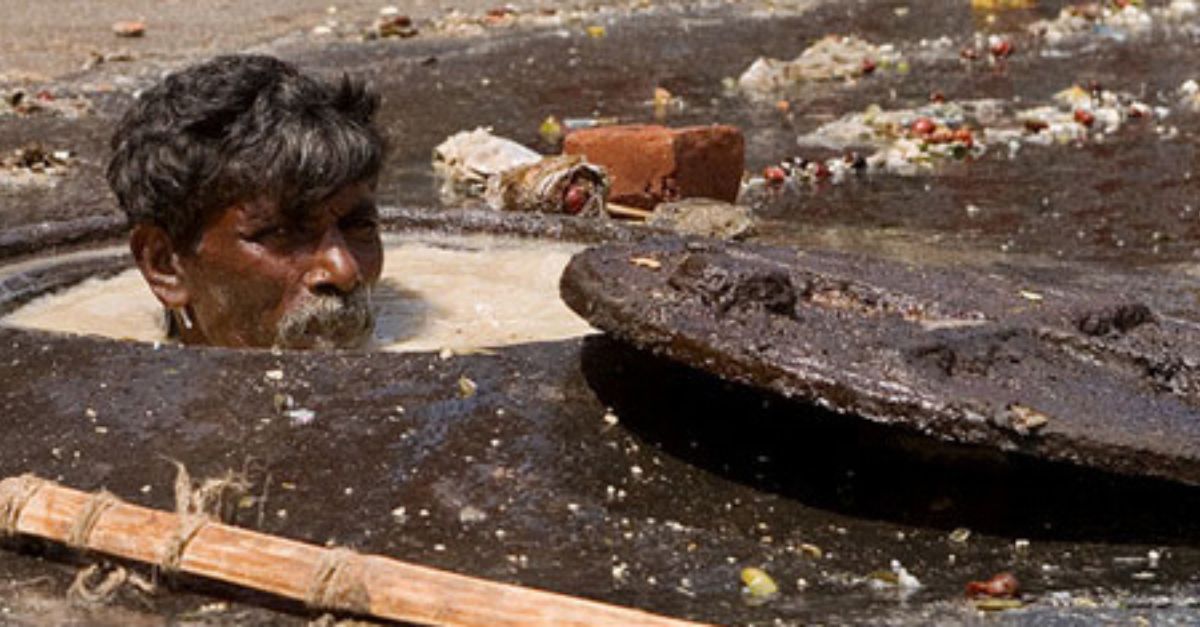

We proudly narrate stories of our nation’s progress. We speak on every platform about the success of Chandrayaan, Digital India, and the rapidly growing economy. But behind this radiant picture lies darkness that of sanitation workers who descend into sewers, risking their lives. This darkness is not confined to the drains alone; it runs deep within the mind of our society.
The practice of manual scavenging, carried on for hundreds of years, continues in India even today. This is not merely a social problem it is a matter of national shame for us and for those who call this a developed economy. In any civilized democratic society, such occurrences raise serious questions about that society’s sensitivity. When a person descends into a sewer or septic tank merely to survive and loses his life there, where does the civilization we claim to uphold disappear? That is the question that arises here.
To live, to clean another’s filth to surrender oneself to death this is inhuman and barbaric. According to figures announced by the Dalit Adivasi Shakti Adhikar Manch, 116 workers died due to manual scavenging in 2024, and in 2025 this number rose further to 158. This means that every two to three days, a person in our country dies while cleaning a sewer or septic tank. And all of this continues because society is numb, the administration is indifferent, and politicians see no need to act.
According to information provided by the Central Government in the Rajya Sabha, 315 sanitation workers died between 2021 and 2025. Maharashtra recorded the highest number with 53 deaths, followed by Haryana with 43, Tamil Nadu with 38, Uttar Pradesh with 35, Delhi with 26, Gujarat with 25, and Rajasthan with 24. But it is difficult to trust even these figures, because in reality the numbers are many times higher. In rural areas, remote regions, and under the pressure of contractors, countless deaths are never recorded.
According to data from the National Commission for Safai Karamcharis, a total of 1,313 sewer and septic tank deaths were recorded from 1993 to June 2025 meaning an average of 41 lives are lost every year to this banned practice. Bezwada Wilson, National Coordinator of the Safai Karmachari Andolan, states that even this figure is far lower than reality, as many deaths are never reported.
In Delhi, five sewer deaths were recorded between January and August 2025, and a sixth death occurred in September. In all of 2024, seven deaths were reported in Delhi. Delhi now holds the worst record in the country for manual scavenging deaths, and not a single affected family has received compensation to date. If this is the condition in the capital, the thought of what the rest of the country must be enduring sends a shiver down the spine.
One need not dig very deep to find the root of all this suffering. Although Dalits constitute only 16 percent of India’s population, 97 percent of manual scavengers are Dalit. This is no coincidence it is the outcome of thousands of years of the caste system. The system that decided certain people were born to clean filth has today changed its laws, but left the mentality intact.
In Parliament, the government stated that this work is based on occupation, not caste, and that caste-wise data of deceased workers is not maintained. Consider how much hypocrisy is concealed in that single statement on one side, 97 percent of those doing this work are Dalit, and on the other, the government claims it is not caste-based.
Now let us look at the law. In 1993, the first law arrived, banning manual scavenging — and it remained on paper. In 2013, a second law came — the Prohibition of Employment as Manual Scavengers and their Rehabilitation Act. The Supreme Court, on 27 March 2014, ordered that sending anyone into a sewer without safety equipment is a punishable offence, carrying a fine of two lakh rupees or two years imprisonment.
In October 2023, the court again issued orders, raising compensation from 10 lakh to 30 lakh rupees. In January 2025, the Supreme Court ordered a complete ban on manual sewer cleaning in six major cities — Delhi, Mumbai, Chennai, Kolkata, Bengaluru, and Hyderabad — and directed municipal heads to submit affidavits by February. But no such action followed. Laws arrive, orders arrive, and compensation increases but deaths do not stop. This is like continuously changing bandages instead of healing the wound.
The government stated in Parliament on 29 June 2025 that ‘no instances of manual scavenging have been found in the states’ and that ‘no deaths due to manual scavenging have been reported.’ Yet at the same time, the NCSK’s data shows deaths continuing. On one side bodies are found; on the other, the government says there are no deaths. What should one call this pretense?
The government creates an artificial distinction between ‘manual scavenging’ and ‘hazardous sewer cleaning’ to wash its hands of responsibility. When a worker dies, it is termed an ‘accidental death.’ This game of official language plays with human lives. India’s ‘Digital India’ where on one side Chandrayaan lands on the moon, and on the other, people still suffocate and die in toxic gases inside dark sewers. What a tremendous contradiction this is!
Now consider the matter of mechanization. Under the NAMASTE scheme, by August 2025, digital registration of 85,819 sewer and septic tank workers was completed, 76,736 workers were provided PPE kits, and 60,586 workers were given Ayushman Bharat cards. These figures sound reassuring, but an immediate question arises if machines have arrived and PPE kits have been provided, why do deaths not stop?
In Maharashtra, though the ‘Manhole to Machinehole’ scheme has been launched, in many cities the machines lie collecting dust because there are no trained operators, no spare parts, or the administration simply has no interest. Because schemes look beautiful on paper — on the ground, the same old story continues.
The National Commission for Safai Karamcharis received 842 complaints last year regarding unpaid wages, lack of safety equipment, and caste-based discrimination 130 of those complaints came from Uttar Pradesh alone. Consider the meaning of this number 842 times in a single year, somewhere a worker did not receive wages, was not given protective equipment, or faced caste-based discrimination. And despite all of this, the government says nothing is wrong.
The most infuriating aspect is the complete absence of punishment. The MS Act 2013 clearly states that sending a worker into a sewer without safety equipment is a punishable offence. Yet not a single contractor who let a worker die in toxic gas has faced criminal charges. The government merely asks sanitation workers to take loans and buy machines themselves — which keeps them tied to the same work, just with machinery. “Machines should be provided by the government. Not providing them is modern-day untouchability.” This is not administrative indifference — it must be called administrative complicity.
Tamil Nadu has begun using the robotic device ‘Bandicoot’ in some cities; IIT Madras has developed a sewer-cleaning robot; Kerala is training workers to operate machines. These small efforts are rays of hope. The NAMASTE scheme has focused on deploying sewer jetting machines, suction machines, and robotic equipment, training workers as machine operators connecting this not just to safety but also to social dignity. But this is not enough. The pace of mechanization, compared to the rate at which deaths are occurring, moves at the speed of a tortoise.
Dr. B.R. Ambedkar once said: our fight is not for wealth, but for human dignity. Uttering those words today brings shame, because 78 years after independence, that dignity has still not been granted. The entire nation pays tribute to a soldier martyred on the border, but who speaks the name of that anonymous worker who lost his life in a sewer? The soldier guards the nation’s frontiers; the sanitation worker protects our cities from disease. One receives advanced weapons; the other, empty hands. Is this our civilization?
The country dreams of becoming a developed nation by 2047. But a country where people still carry filth on their heads, suffocate in sewers, and where no one feels shame over their deaths — how can that country call itself ‘developed’?
The dignity of labour must not remain confined to speeches — it must be brought to ground level. Every guilty contractor must face imprisonment, every deceased worker’s family must receive timely justice, and every sewer must have a machine descending into it instead of a human being. Otherwise, the wounds of this nation shall remain open and exposed