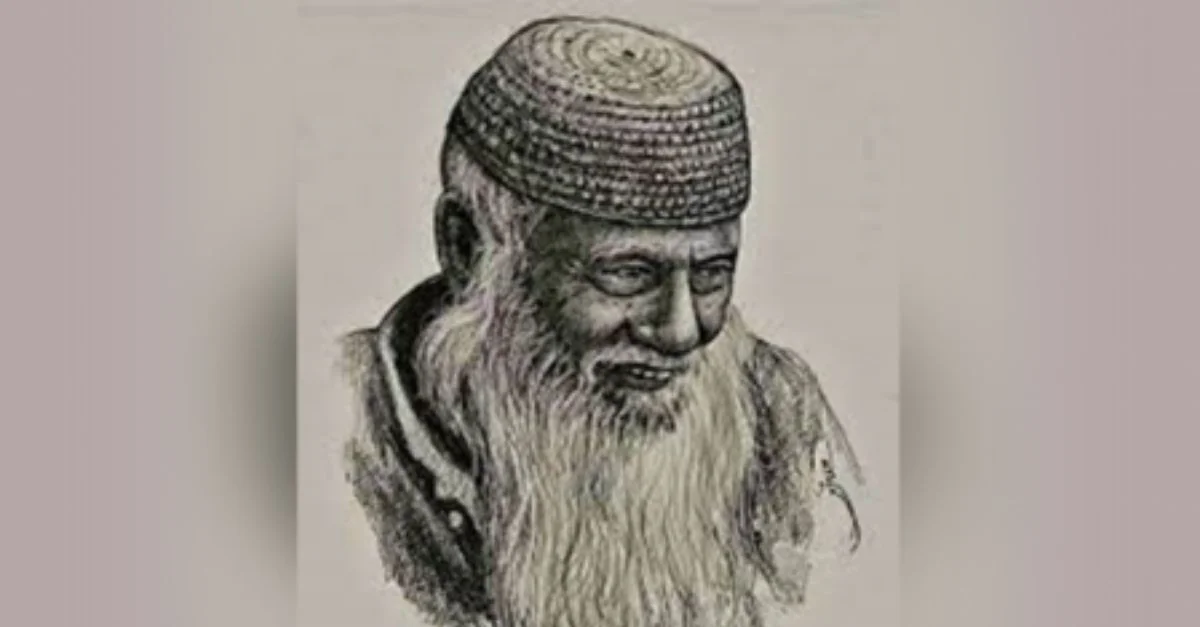

On 17th November 2026, Free Voice organised a discussion on the occasion of 50th death anniversary of Maulana Abdul Hamid Khan Bhashani (1880-1976), popularly known as “Red Maulana”, “Majlum Jananeta”. This was in line with Free Voice’s promise of conducting regular discussions on luminaries. Earlier, Free Voice conducted a session on Netaji Subhas Chandra Bose and his contribution to the freedom struggle in January 2026.
Abu Siddik, founding editor of Free Voice, introduced Maulana Abdul Hamid Khan Bhashani to the audience, sharing his reflections on the remarkable life and legacy of this great political and social leader. Siddik mentioned that he had been studying Bhashani’s life and contributions for several years, although much of the available literature on him remains in Bengali and is therefore not easily accessible to a wider readership.
Born into a humble peasant family, Bhashani remained deeply connected to the lives, struggles and aspirations of Bangla-speaking peasants throughout his life. He relentlessly fought for their rights, dignity and fair share in the country’s economic and material resources. Neither political power, personal fame nor material comforts could distract him from his mission. Instead, he devoted his entire life to the struggle for the poor, the marginalised and the exploited.
His commitment to the people remained unwavering even in old age. Remarkably, at around 90 years of age, he was still marching alongside the poor peasants of Bangladesh, raising his voice against injustice and exploitation. For Bhashani, politics was not a means of acquiring power but an instrument of social transformation and service to humanity.
Concluding his remarks, Siddik emphasised that today’s younger generation needs visionary leaders like Maulana Bhashani as role models. His life offers an enduring lesson in courage, simplicity, selflessness and commitment to social justice. The central message of Bhashani’s philosophy was that serving the oppressed, the deprived and the exploited is itself a form of service to the Almighty. This profound belief shaped his lifelong struggle and continues to hold relevance in a world marked by inequality and injustice.
Next speaker was Zeeshan Husain, a sociologist by training. He acknowledged his limited understanding of Bhashani and Bengal’s history and society at large. He highlighted the importance of Bengal Pact which was drafted by Chittaranjan Das in 1923 and later supported by Netaji. Husain said that there is another Maulana, Maulan Azad (1888-1958). Azad was born in Calcutta and became president of INC at the young age of 35. For Azad Islam, pluralism and nationalism overlapped. Husain also gave examples of Khan Abdul Ghaffar Khan (1890-1988) and Hasrat Mohani (1875-1951) who contributed in the freedom struggle very strongly. For Mohani, Islam and socialism were similar in spirit. This strand of thought was also actualised through the Progressive Writers’ Movement.
After that 2 partcipants from the audience spoke briefly why Bhashani matters today, his vision of a just world of economic and social equality, his unwavering commitment towards the cause of Bangla speaking peasants of Assam, Pakistan and Bangladesh, his life-long non-communal attitude, his sheer courage and honesty, his immense power as an organiser, etc.
In the question and answer session, some young students enquired about the history of Bengal’s partition. All speakers agreed on the importance of economic equality and religious pluralism. They all emphasised human virtues, social justice and critical thought. They said that the propagation of knowledge should be for spreading love, communal amity and economic justice.
we all agreed that in the present age of short reels, toxicity engulping every speheres of life, and consumption when everything, even the private emotions and feelings, has become a product to be exhibited, sold and bought in the 24×7 market, to speak of Bhashani is urgent to motivate us towards a path of life, based on idealism, truth, and commitment towards the working people. They requested us to arrange such online, and if possible offline event in future.
In the coming months, Free Voice plans to continue such discussions. Till now, we have covered Netaji and Bhashani. In coming years, we intend to hold discussions on freedom fighters, books, academic articles and even movies with social values. Our overall purpose is to serve society through knowledge and critical enquiry.
If you have an idea for such a session, write to us at: editor@freevoice.co.in. We will reply to you in a week.